What New Style of Art Was Developing During the 1730s
Art Deco was an art movement that was initially unveiled at an exhibition held in Paris in 1925. While it reached the elevation of popularity during the 1920s, 1930s, and 1940s, Fine art Deco was actually a movement that had been in development for more than than a decade prior to its announcement. Seen as a very decorative art way, Art Deco artists soon experimented with the genres of pattern, painting, furniture, architecture, and building within its stylistic realm.
Table of Contents
- ane What Is Art Deco?
- 2 A History of the Fine art Deco Move
- ii.1 The Society of Decorative Artists (1901 – 2000s)
- two.2 The Exhibition That Formally Initiated the Start of the Art Deco Motion
- 3 An Appropriate Art Deco Definition
- four Different Forms of Art Deco Art
- 4.1 Art Deco Blueprint
- 4.2 Art Deco Furniture
- iv.3 Fine art Deco Compages
- iv.4 Art Deco Building
- 5 Key Accomplishments of Art Deco
- 5.1 Fine art Deco in America
- 6 Late Art Deco
- seven Notable Art Deco Artists
- 7.1 René Lalique (1860 – 1945)
- 7.2 Émile-Jacques Ruhlmann (1879 – 1933)
- 7.3 William Van Alen (1883 – 1954)
- 7.4 Sonia Delaunay (1885 – 1979)
- 7.5 Tamara de Lempicka (1898 – 1980)
- 8 The Legacy Left by Art Deco
- 9 Frequently Asked Questions
- nine.1 What Is Art Deco?
- 9.two What Are the Main Characteristics of the Fine art Deco Mode?
- 9.3 What Are Some of the Most Iconic Art Deco Pieces Made?
What Is Art Deco?
Sometimes referred to as simply "Deco", Art Deco was an art fashion that was characterized by vivid colors and daring geometry that led to extremely luxurious and detailed artworks. Equally a visual arts style that incorporated both elements of compages and design, Art Deco outset appeared in France but earlier the get-go of Earth State of war One. However, this movement was only announced to the public in 1925 at the Exposition Internationale des Arts Décoratifs et Industriels Modernes, which was loosely based around the concept of the World's Fair.
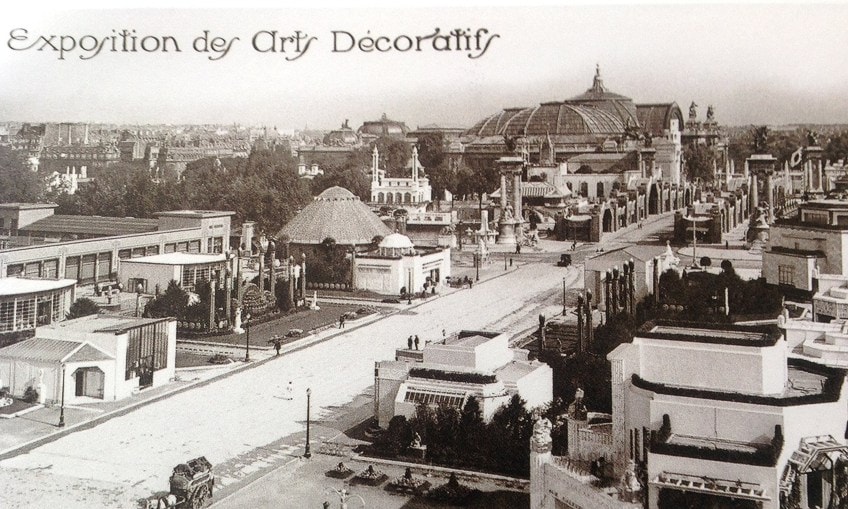 Postcard of the overview of the 1925 Exposition of Decorative and Industrial Arts;SiefkinDR, CC BY-SA 4.0, via Wikimedia Commons
Art Decorates, equally it was sometimes known, went on to influence the blueprint of furniture, jewelry, fashion, cars, theatres, trains, and even buildings. Everyday objects, such every bit vacuum cleaners and radios, were not immune to the impact fabricated by Fine art Deco and incorporated tell-tale characteristics of the iconic way.
As it worked to integrate advanced styles with exceptional artistry and decadent materials, Art Deco went on to stand for opulence, elegance, vitality, and trust in the social and technological progress that occurred in its prime number.
From the outset, Art Deco proved to be influenced past the assuming geometric forms fabricated famous by the Cubism movement, as well as the bright colors used within Fauvism. Bringing with it a great sense of order, the Fine art Deco way presented proportionate and balanced designs in lush and cheerful shapes. Art Deco design managed to discover its way into many early on 20th-century design forms, with the movement experimenting with elements of art, architecture, fashion, furniture, forms of transport, and even ordinary appliances.
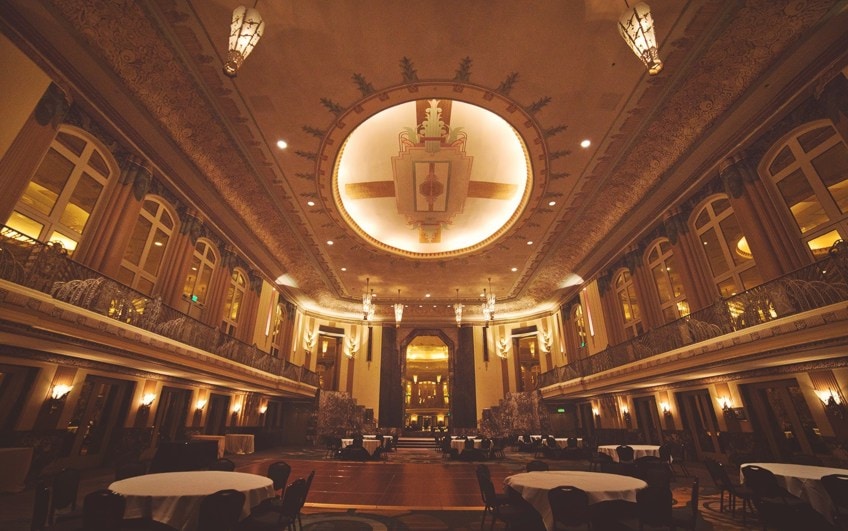 Hall of Mirrors in Carew Tower;Laura Mckenzie Waters, CC BY-SA 4.0, via Wikimedia Eatables
As an art movement, the features that defined Art Deco were easily identifiable. Deco art was typically recognized as a mishmash of different styles and seen as an eclectic amalgamation of various influences, materials, and shapes. Due to this, it can exist hard to differentiate the Art Deco style from other similar schools of art like Art Nouveau, Art Moderne, the Bauhaus school, or the Arts and Craft motion.
Despite that, the Art Deco period was an incredibly influential ane, with its decorative manner going on to inspire a variety of other creative styles.
A History of the Art Deco Movement
Towards the end of the 19th century, many French artists, architects, and designers who were instrumental in the development of Art Nouveau noticed that the movement had become very outdated. With the twentyth century close approaching, and the effects of the Industrial Revolution coming into play, creatives were inspired to produce a manner of art that would scream "tasteful and mod" from the rooftops. The Art Deco catamenia was determined to restore France'south reputation as the start-form creator of decorative arts in one case over again.
The institution of the Salon or Société des artistes décorateurs in French republic, who designed furniture, interiors, and fine art, helped raise the respect for art objects.
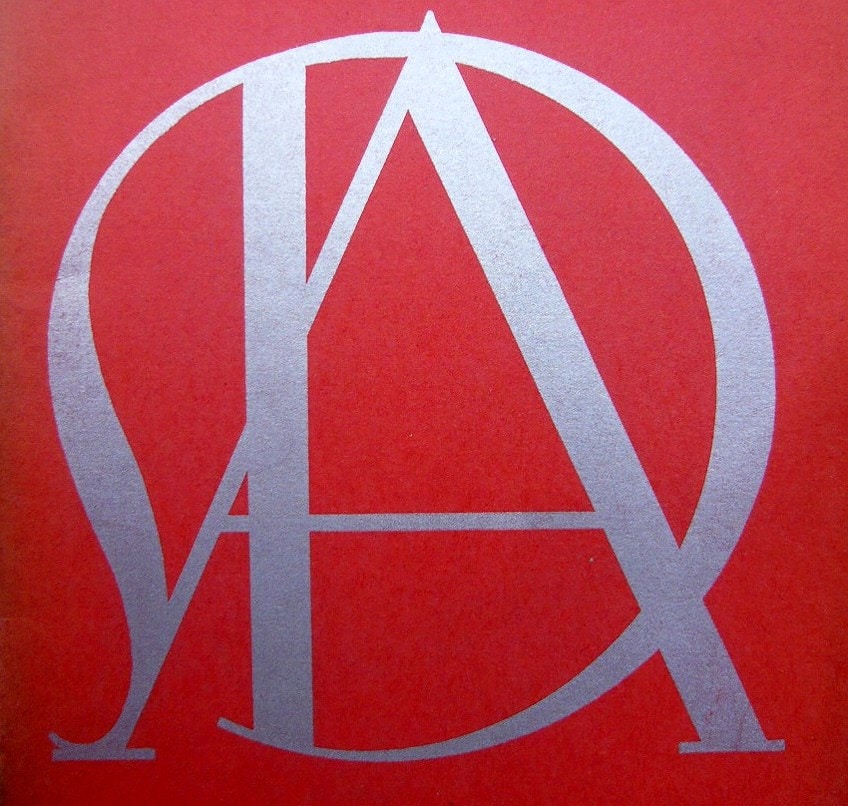 Logo of the Société des artistes décorateurs (Deplorable), designed by Gustave Miklos, 1930; Pierre gencey, CC BY-SA 3.0, via Wikimedia Commons
This club helped to slowly expand the definition of art across painting and sculpture into other domains that had non been considered before, such as glassware and jewelry. Eventually, those who created Art Deco works that were non considered to be "fine fine art" before were suddenly viewed every bit artists instead of mere artisans.
The polished and streamlined manner that was Art Deco grew out of a longing and assertive want to be free of the past and to welcome the time to come in all of its manufactured and machine-driven brilliance.
The prominence of the Art Deco era rose and roughshod in between the two Earth Wars, with the mode playing an important office in molding the West's modernistic vision. This was particularly noticeable in France and the The states, where the influence of the Fine art Deco style could exist seen in the types of architecture that were used.
While Fine art Deco emphasized the features of speed, power, and progression, its artworks were assorted with the lighter and more delicate elements of the previous Art Nouveau movement to create a truly unique fashion. Art Nouveau, which was a predominant style earlier the First Earth State of war, was heavily inspired past the natural world and incorporated things similar winding vines, blossom petals, and flowy waves in the artworks created. This celebration of organic shapes differed greatly from the clean and geometric style of Art Deco.
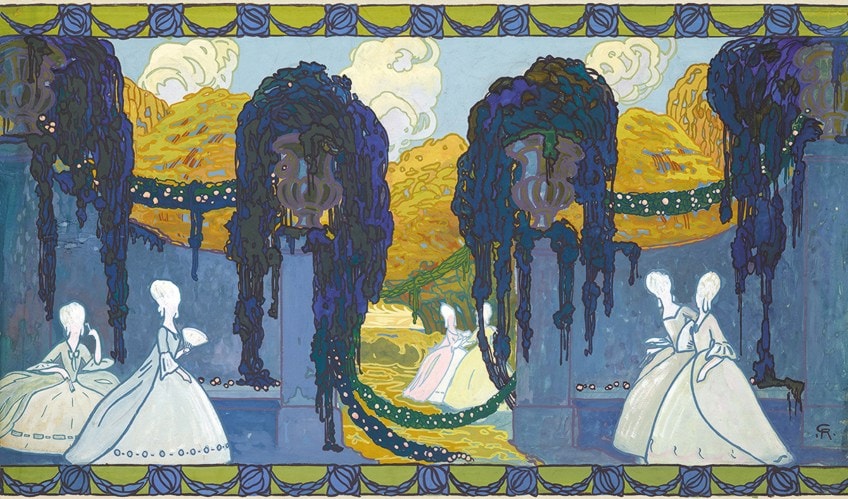 An early on Fine art Deco-fashion painting by René Crevel, 1915;René Crevel, CC0, via Wikimedia Commons
Seen as quite a structured mode, Art Deco took on a very Gatsby-esque self-indulgence based on the types of works created. Adopting features from F. Scott Fitzgerald'south iconic novel, The Swell Gatsby, the Art Deco mode celebrated the flamboyance, frivolity, and decadence that emerged during the 1920s in America. Merely every bit the characters inside Fitzgerald's book were fixated with the glitz and glamour that was synonymous with the lifestyle at the time, Art Deco historic everything that was considered to be luxurious and forward-thinking.
As an fine art fashion, Art Deco was considered to be one of the most exciting eras of blueprint.
It latched onto the flourishing mail service-state of war America with its new inventions that were available to even the average person, which led consumer tastes for luxury to go through the roof. Equally a result, the Art Deco style was forced to rapidly develop to reflect this intoxicating sense of progress. Art Deco also evolved alongside other avant-garde movements and aspects of civilization at the time, which resulted in a blend of fine art, design, mode, and performance.
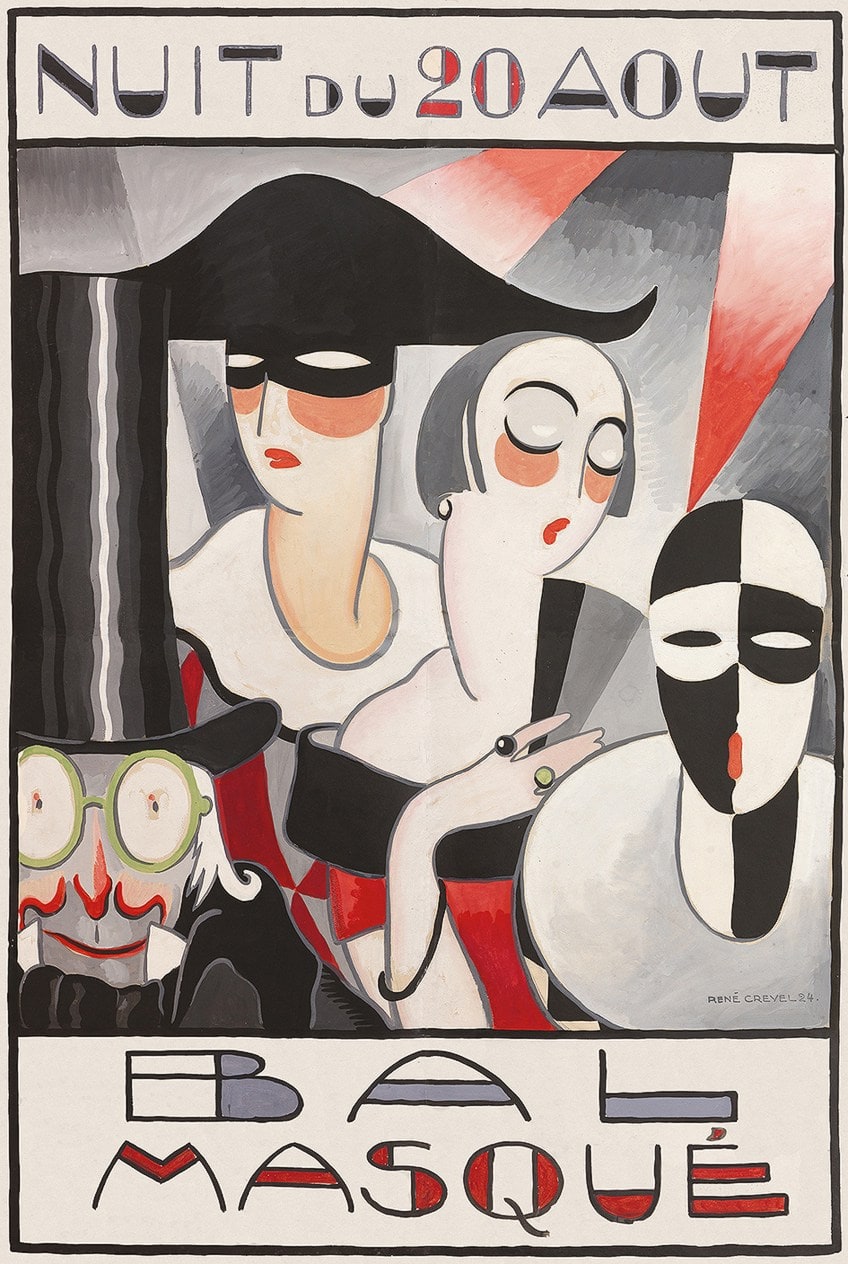 Art Deco-mode Masked Ball affiche by René Crevel, 1924;René Crevel, CC0, via Wikimedia Commons
During the Keen Depression in the 1930s, Deco fine art became more subdued as popular taste shifted towards less ostentatious forms that included materials like stainless steel, chrome plating, and plastic. However, the style quickly went out of fashion during World State of war Two.
During the 1960s, a restored fascination in Art Deco design was fostered and equally of today, Art Deco continues to be a key motivation in areas of decorative art, style, and fifty-fifty jewelry design.
Representing modernism that was turned into manner, Fine art Deco exists equally ane of the first truly international styles. The purpose backside the artworks was to create a stylish and anti-traditional form of refinement that represented wealth and sophistication. Art Deco marked a time of newly discovered optimism later World War Ane and oriented itself towards the future and gimmicky notions of progress.
The Society of Decorative Artists (1901 – 2000s)
Art Deco reached its peak in 1925 when the French government promoted the Exposition internationale des arts décoratifs et industriels modernes. The only real requirement to exhibit at this fair was that all artworks needed to be "thoroughly modern", which demonstrated the focus of the move. The exhibition proved to be incredibly popular and was widely visited, which helped to firmly establish Art Deco in art history. The show also prompted the official proper name of the movement, Arts Decorates.
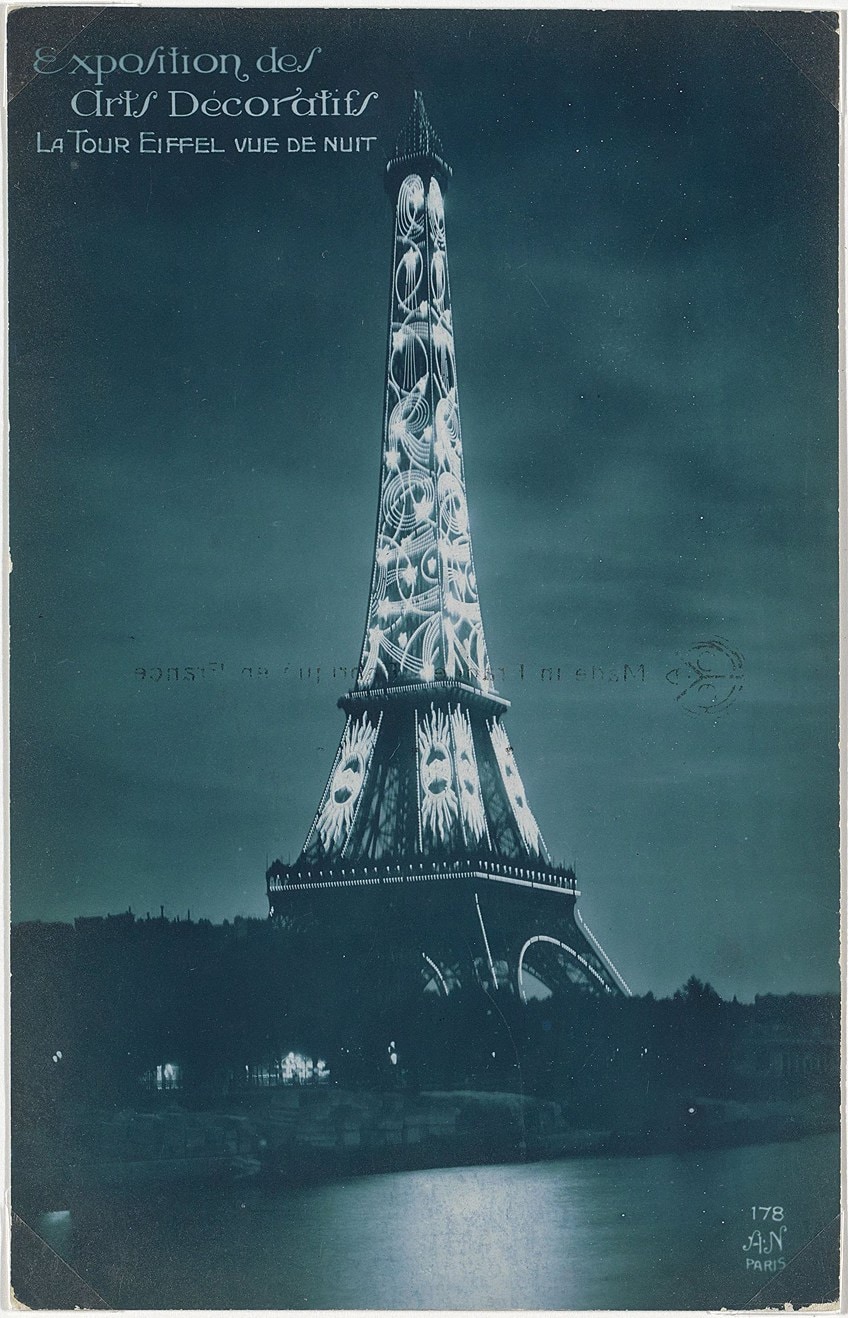 Postcard of the Eiffel Tower at nighttime with the discussion "Citroën" in the illuminated letters, Exposition des Arts Décoratifs, 1925; Rijksmuseum, CC0, via Wikimedia Commons
This club was made upwardly of famous figures in the art world, similar Art Nouveau designer and printmaker Eugene Grasset, and Art Nouveau builder Hector Grimard. Other budding decorative artists and designers also joined this group and helped with the evolution of its style. The French government proved to exist incredibly supportive of this style of art and helped encourage the growth of this creative activeness.
I of the major goals of this group was to contest the hierarchical organisation of the visual arts that demoted decorative artists to an inferior condition when compared to the more traditional painting and sculpting forms.
This was because the Art Deco fashion was treated as the "Cinderella" of the art world – supposedly inadequate in comparison to the other forms of art that existed. Based on this, the purpose of the exposition was to introduce the new type of decorative art that had formed merely was postponed for several reasons until 1925.
The Exhibition That Formally Initiated the Start of the Art Deco Movement
The French government, which hosted the Exposition International des Arts Decorates et Industrials Moderns were seen equally responsible for introducing the Art Deco style into the art world. More than fifteen,000 artists, architects, and designers went on to nowadays their works at this exhibition that ran for seven months, with over 16 million people from around the earth coming to view the individual exhibits. Therefore, this exhibition was regarded every bit the catalyst that launched the starting time of the Art Deco movement.
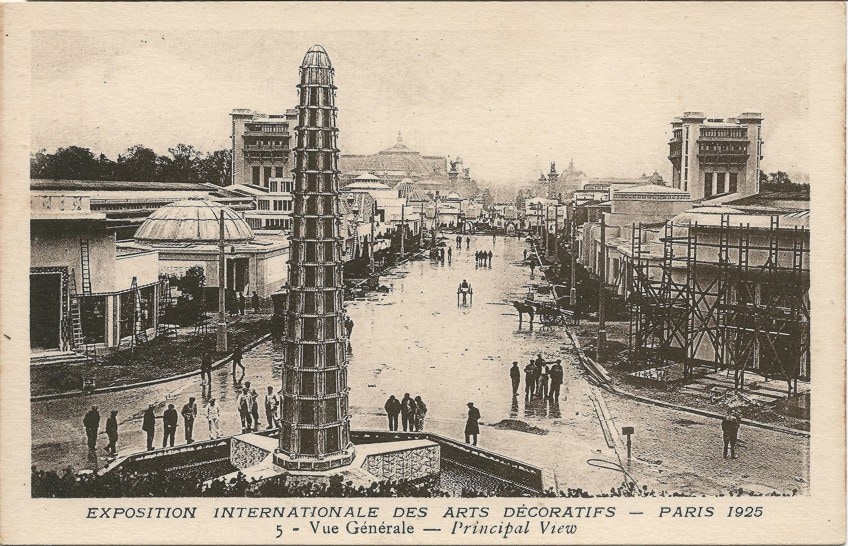 Postcard of the general or principal view of the Exposition Internationale des Arts Décoratifs et Industriels Modernes, Paris, 1925;Unknown author Unknown author, Public domain, via Wikimedia Eatables
An Appropriate Art Deco Definition
When talking about a suitable Fine art Deco definition, the fact that it was ane of the most influential and decorative styles from the beginning of the xxth century is usually included in the interpretation. Taking its name from the International Exhibition of Modern Decorative and Industrial Arts, the term "arts decorates" was first used in France in 1858 before the iconic characterization of "Art Deco" was decided on. Once the movement had a proper name, it chop-chop gained acceptance around the world.
At first, the term "Art Deco" was used in a disdainful mode by the modernist builder Le Corbusier.
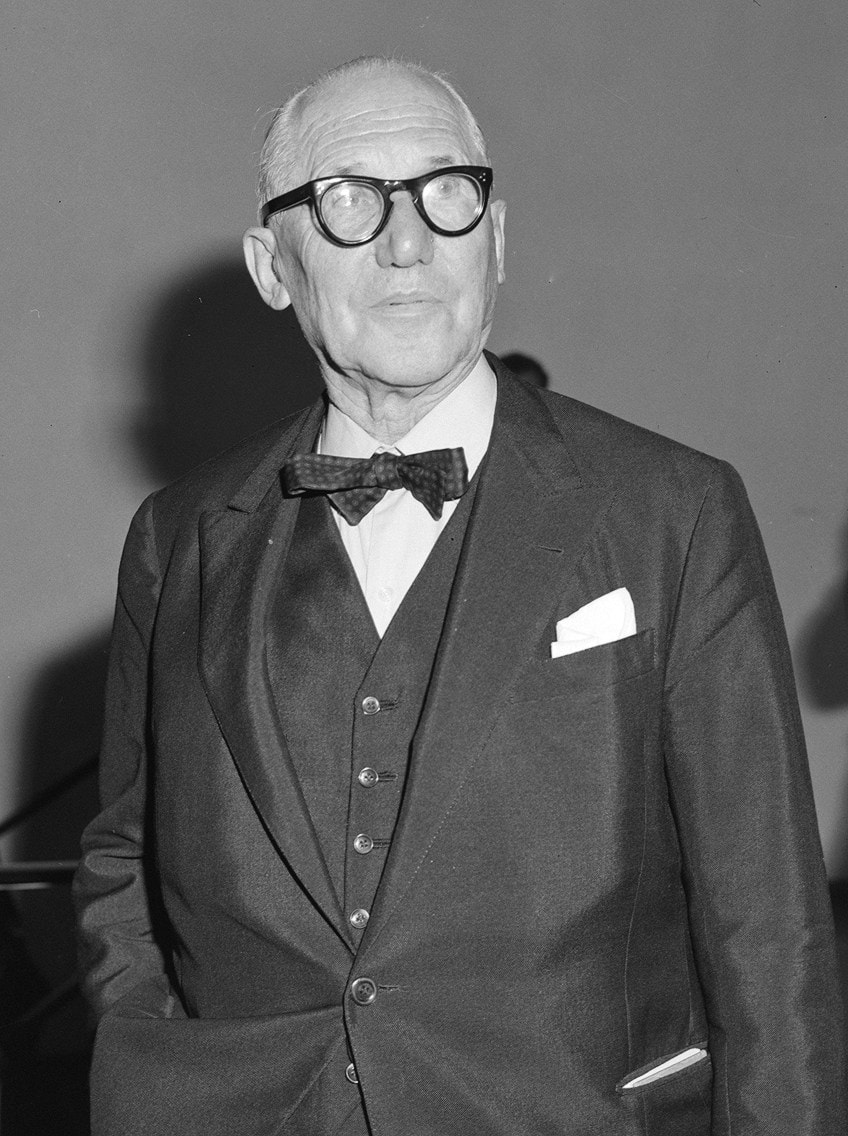 Le Corbusier, 1964;Joop van Bilsen / Anefo, CC0, via Wikimedia Eatables
The name was used in articles where he mocked the style for its embellishment, which was a feature that Le Corbusier considered to be useless in mod architecture. While supporters of the Art Deco style praised it for its stripped-down approach, its proper name was nevertheless met with much scorn. Merely in the late 1960s, when a greater interest was starting to exist paid towards the style, was the Art Deco definition restored.
The Art Deco definition was used in a positive mode for the get-go time by British critic and fine art historian, Bevis Hillier. His definitive use of the term "Art Deco" in his kickoff book, Art Deco of the 20s and 30s, properly cemented the name into fine art history.
Based on this, the Art Deco definition described the movement every bit ane that was made upwards of assuming geometric shapes and strong colors that were used in a variety of fine art forms, almost notably in architecture and objects.
Dissimilar Forms of Fine art Deco Art
The Art Deco flow was characterized by harmonious, clean, geometric, sleek, usually uncomplicated, and visually pleasing artworks. The way'south chief visual features derived from repetitive use of linear shapes that frequently included triangular, trapezoidal, zigzag, and chevron-patterned forms. Similar to the precursor movement of Art Nouveau, objects like humans, animals, or even flowers were rendered in a highly stylized and streamlined way in social club to maintain the general aesthetic of Art Deco.
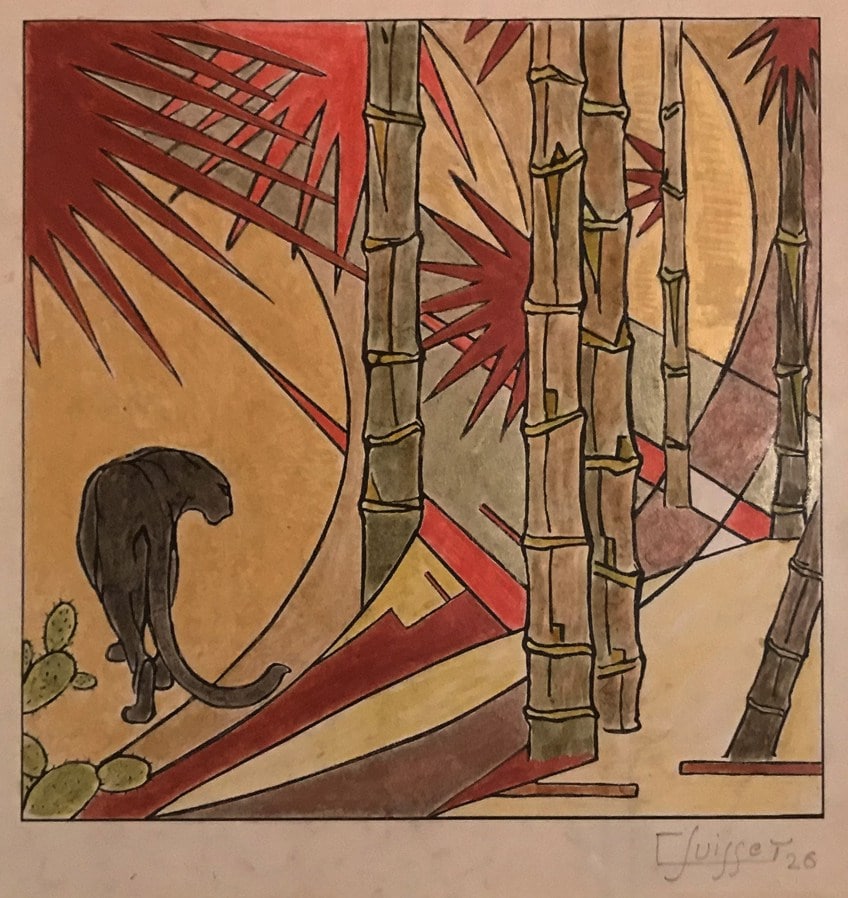 Art Deco-manner painting, Black Panther in the Bamboo (1926) by Gaston Suisse;Dominique Suisse, CC BY-SA 4.0, via Wikimedia Commons
In order to go on up with the style'south emphasis on modern technology, Art Deco artists joined natural materials with modernistic and human being-fabricated ones like synthetic plastic, drinking glass, reinforced concrete, and stainless steel. Yet, when a splash of sophistication was needed from Art Deco artworks, designers worked to incorporate more unusual materials into their works to give off a wealthier feel, such equally ivory, horn, and even zebra skin.
Based on this style, the Art Deco movement was less connected to the traditional supposedly superior forms of fine art that were made up of painting and sculpture.
As Art Deco design was influenced by industrialization and the technical advancements in society, artworks displayed approval for the modernity of the machine and the innate design qualities of machine-made objects. This led to Fine art Deco primarily being experimented within design, furniture, architecture, and buildings.
Art Deco Blueprint
When it kickoff appeared, the Fine art Deco style wielded its impact all over the graphic art of the time. This was done in such a style that the touch on of Italian Futurism was revealed, as the style's passion for speed and its devotion to the machine could be seen in the works produced.
The utilize of lines to denote movement, made famous by Futurist artists, was used by Art Deco creatives in the course of parallel lines and narrowing forms to indicate the concept of balance and streamlining.
 Fine art Deco-style fictional Mars tourism affiche commissioned by SpaceX. This poster advertises for Olympus Mons, 2015;SpaceX, CC0, via Wikimedia Commons
Art Deco blueprint went on to characteristic many aspects that implied movement during the mid-1930s, as movement demonstrated an influence from advanced aerodynamic standards that were developed for aviation and ballistics to diminish aerodynamic elevate at loftier velocities. Shapes that helped to signify motility were so used in many different Art Deco designs and even featured in objects that were genuinely non intended to always move, such every bit refrigerators and buildings.
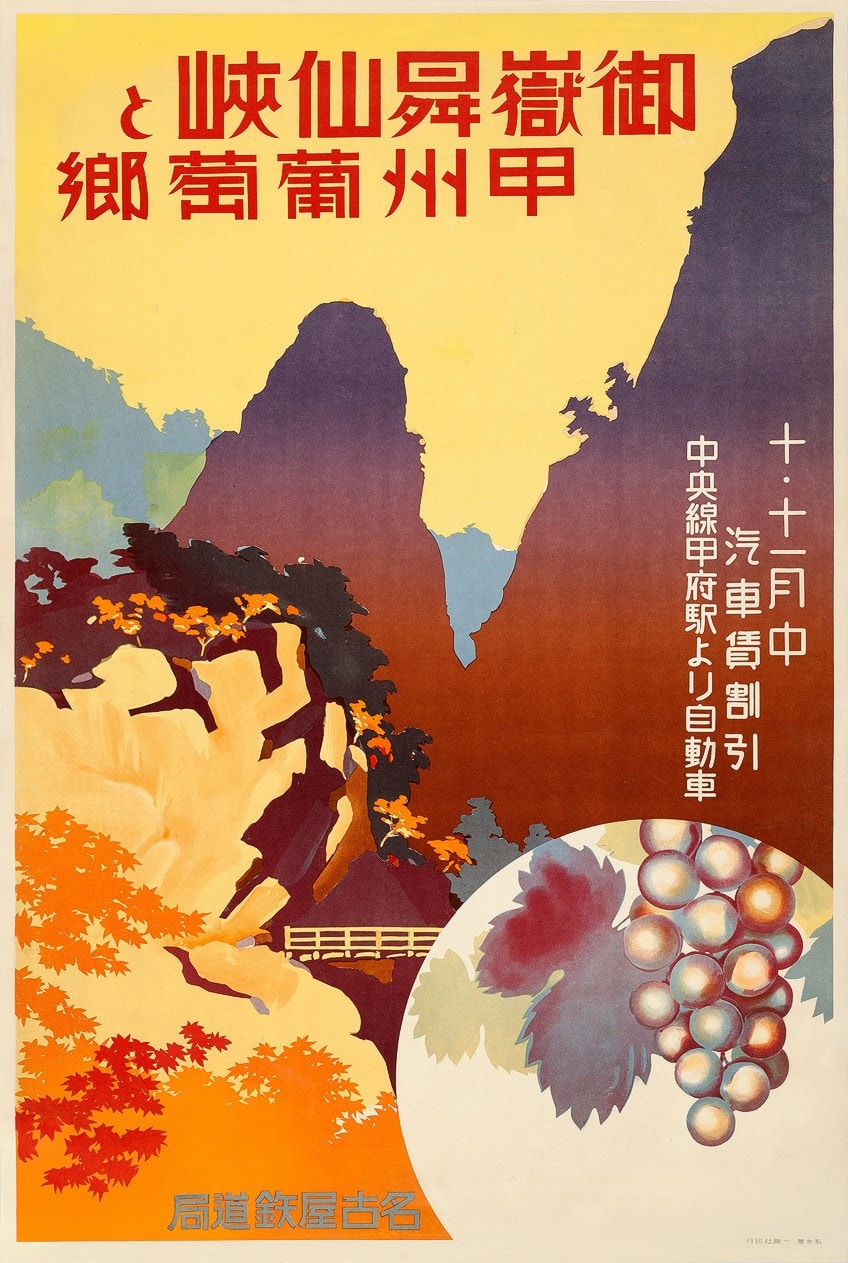 Fine art Deco-fashion Japan travel poster, Ontake Shosenkyo Valley (Nagoya Train Agency, 1930s);Nagoya Train Bureau, Public domain, via Wikimedia Commons
In terms of the imagery produced, Art Deco design elements could exist seen in the basic forms and huge sections of solid colors that were used. These features were similar to Japanese woodblock prints, which Fine art Deco artists looked to for inspiration. The influx of Japanese fine art into Europe following the First World State of war left a great impact on countries, about notably France.
Artists found that the simplicity of these woodblock prints mirrored the clearly modern and sleek styles that Art Deco was attempting to create.
Art Deco Furniture
Another prominent characteristic of Fine art Deco art was the piece of furniture that was produced during the movement's era. It was non until the belatedly 1920s that the concept of furniture was even explored, with the avant-garde Fine art Nouveau article of furniture designs going on to inspire the up-and-coming Fine art Deco creatives. The types of piece of furniture that were then created nether the new Art Deco fashion proved to be more basic and less arched in design, with modernity existing equally the chief message.
Equally the Fine art Deco movement continued, Émile-Jacques Ruhlmann appeared to exist the precursor in article of furniture.
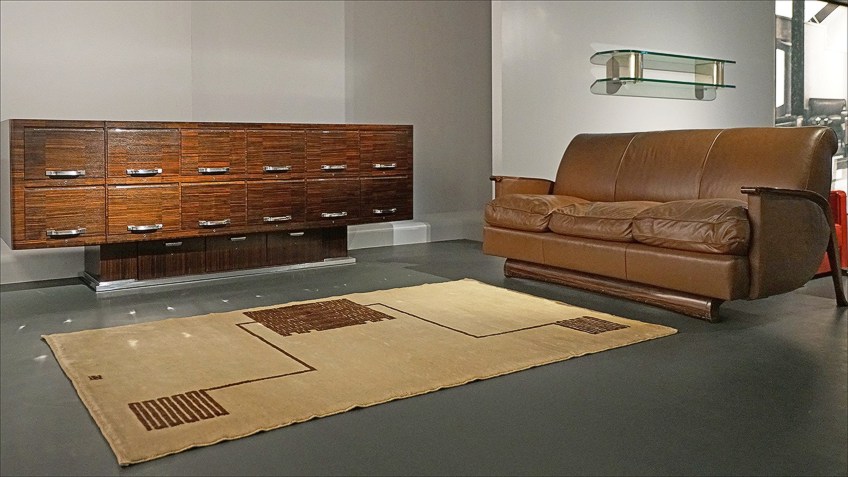 Art Deco-style report of the Maharajah d'Indore Mobiliers by Jacques-Émile Ruhlmann, 1932; Jean-Pierre Dalbéra from Paris, French republic, CC By 2.0, via Wikimedia Eatables
While his piece of furniture pieces took inspiration from the Neoclassical fashion of the eighteenthursday century, he worked to remove as much of the embellishment as possible while still using the luxurious materials preferred by Fine art Nouveau designers.
These materials included mahogany, ebony, ivory, and fifty-fifty tortoiseshell. Equally they were completely out of reach for ordinary individuals, his furniture was only available to the most well-off citizens.
As Ruhlmann'due south furniture works appeared to fluctuate between the Fine art Nouveau and Art Deco style, this left a gap in the market for a more definitive Art Deco furniture designer to arrive. This occurred in the form of Jules Leela, who was merely a traditional designer prior to the development of the Art Deco menstruation. Leela, later on finding inspiration in the new and exciting Art Deco style, went on to blueprint the furniture featured in the grand dining room of the Elysée Palace in Paris, which was his most iconic project.
Fine art Deco Architecture
The architecture that emerged from the Art Deco period is peradventure one of the near well-known features of the entire art motility. Making its debut in Paris between 1903 and 1904, Fine art Deco architecture began with the construction of two apartment buildings designed past Auguste Perret and Henri Savage. These 2 architects worked with reinforced concrete for the very outset time in Parisian suburban buildings, with its clean lines, rectangular forms, and lack of decoration on the facade demonstrating a clear deviation from the Art Nouveau mode.
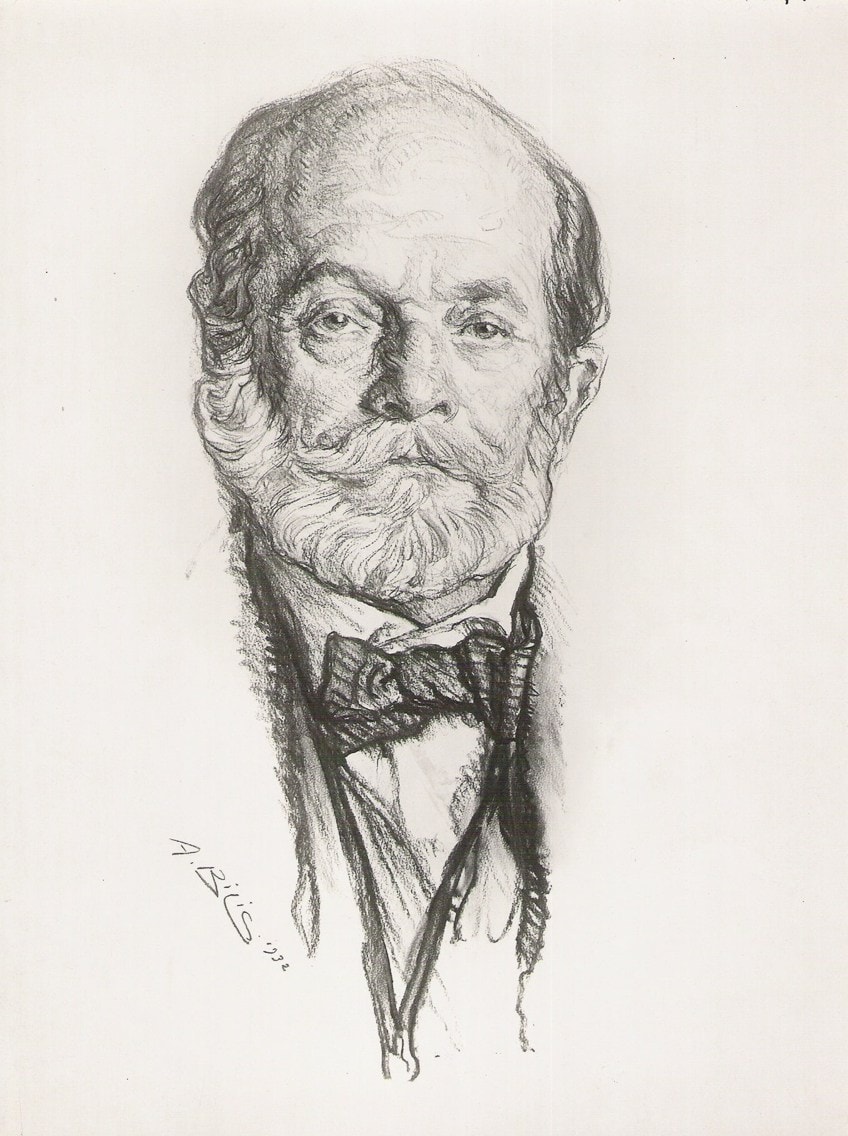 Architect Auguste Perret, 1932; Nadine.bilis, CC BY-SA 4.0, via Wikimedia Commons
Art Deco architecture is therefore distinguished past hard-edged and often amply busy designs emphasized by lustrous metal accents. Many of the buildings designed using the features of Fine art Deco architecture accept an upright accent, as they were congenital in a mode that meant to draw the eyes of those walking on the streets upwardly.
The buildings created in this fashion were oft rectangular, blockish, and organized geometrically, with the improver of curved ornamental features calculation to the sleek effect that was intended.
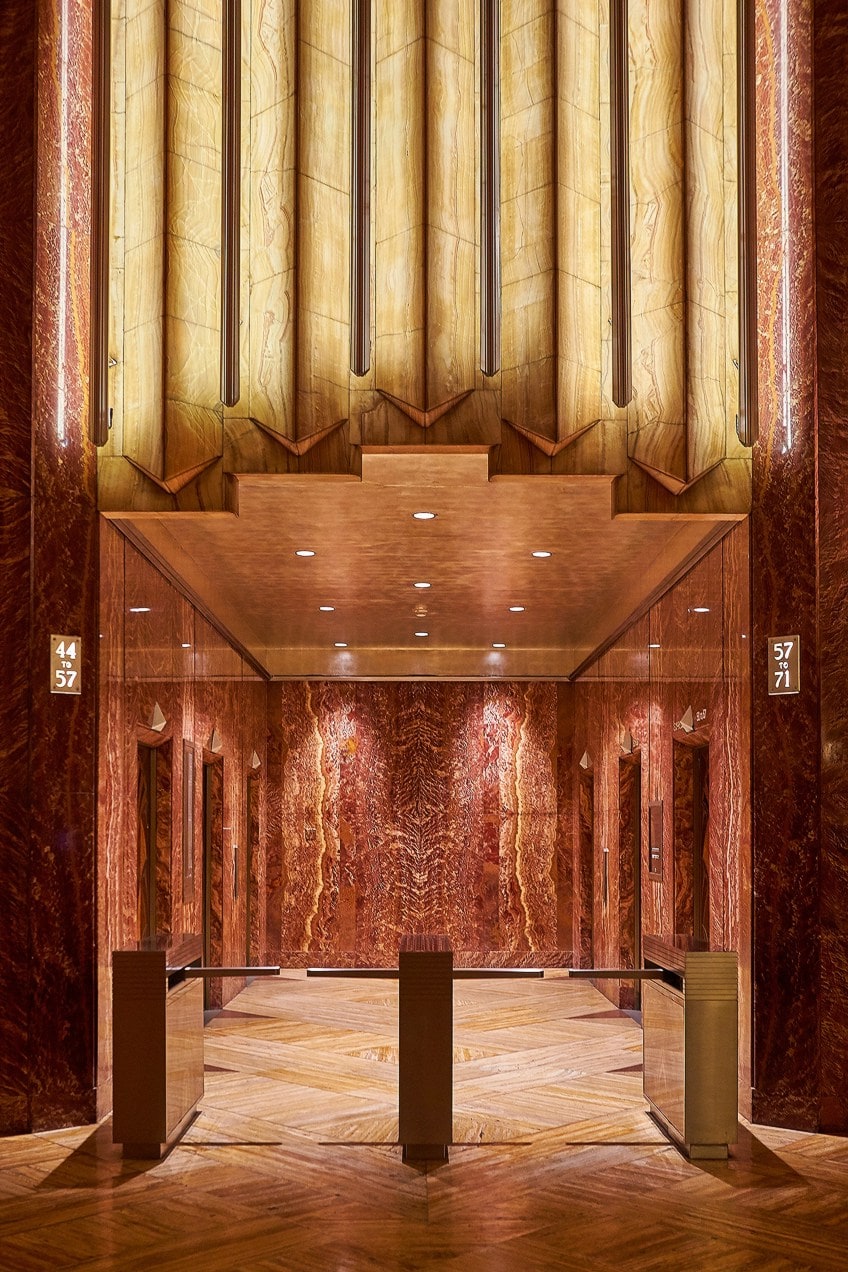 Chrysler Building lobby on 42nd street archway, key elevator bank with Art Deco illumination;"Axel Tschentscher", CC By-SA 4.0, via Wikimedia Commons
Some of the almost famous American examples of Art Deco architecture include a variety of skyscrapers that were built in New York Metropolis, as well as several pastel-colored buildings that were synthetic in Miami. In the Interwar period, Art Deco quickly became the well-nigh common and popular architectural style available and began to spread to other parts of the globe. The influence of Art Deco architecture during the showtime half of the xxth century tin can still exist seen when looking at some of the prevailing buildings that still stand in America today.
Fine art Deco Building
Some of the most recognizable buildings in America today represent the Art Deco style and patterns in its architecture. Later World War One, Art Deco buildings that made use of steel and reinforced concrete began to appear all over big cities in America and Europe. In America, these buildings were typically used for offices, moving picture theatres, railroad stations, and government buildings.
Art Deco building elements also featured in some technology projects, most notably in the towers of the Gilt Gate Bridge in San Francisco.
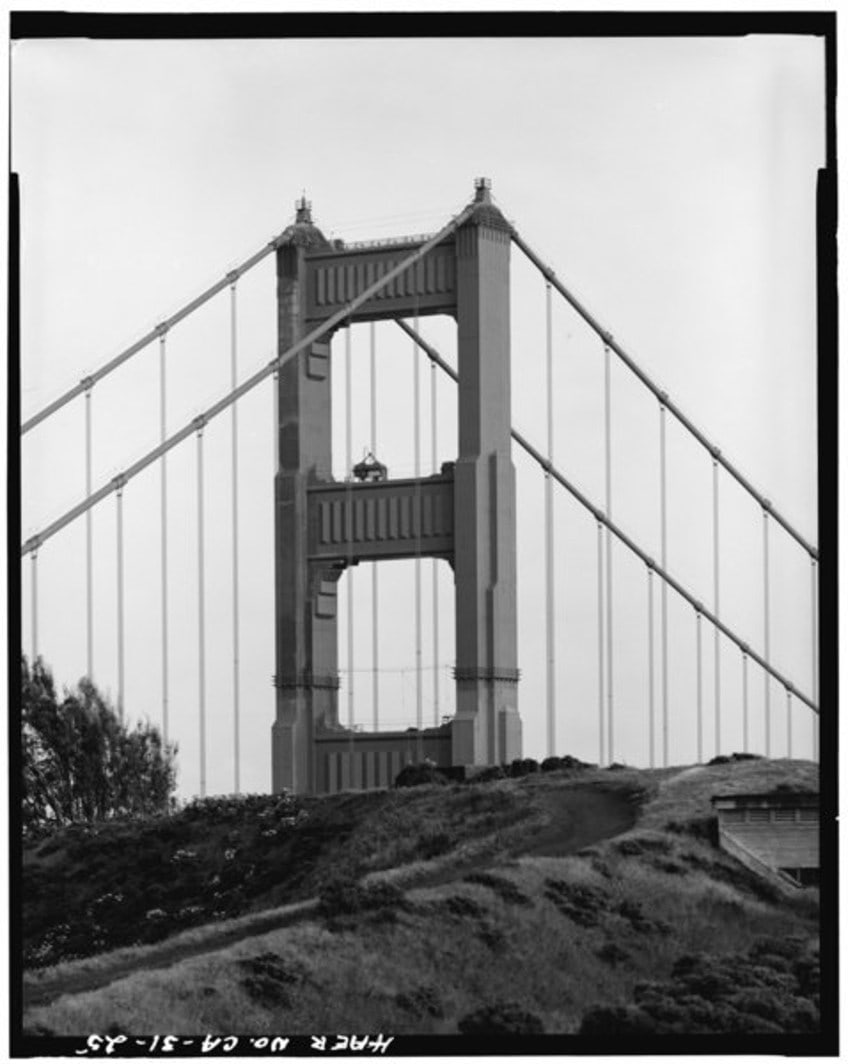 Telephoto view showing the top of the tower of the Golden Gate Span, 1984;Lowe, JetRelated names:Strauss, Joseph BPacific Bridge CompanyJohn Roebling's Sons CompanyBethlehem Steel Company IncorporatedJackson, Donald C, transmitterYearby, Jean P, transmitterJandoli, Liz, transmitter, Public domain, via Wikimedia Commons
The most famous Art Deco buildings, which notwithstanding be in their original form today, include Rockefeller Centre, the Empire State Building, and the truly iconic Chrysler Building, all located in New York Metropolis. Considered to be the virtually commemorative expressions of the Art Deco style, these buildings became the tallest and most recognizable contemporary buildings in the globe at the time. They were essentially designed to demonstrate the reputation of builders through their acme, shape, color, and hitting radiance of the evening.
Skyscrapers were seen as a completely modern creation within the Art Deco era.
These buildings emphasized neat lines and stability at an often-boundless level. New York's skyline was drastically altered by the Chrysler Edifice in 1930, which stood as the superlative of success when it came to Art Deco building. At 77 floors, it was known as the world'due south tallest building for 11 months until structure on the Empire State Building began. The Chrysler Edifice existed as a large commercial for Chrysler cars.
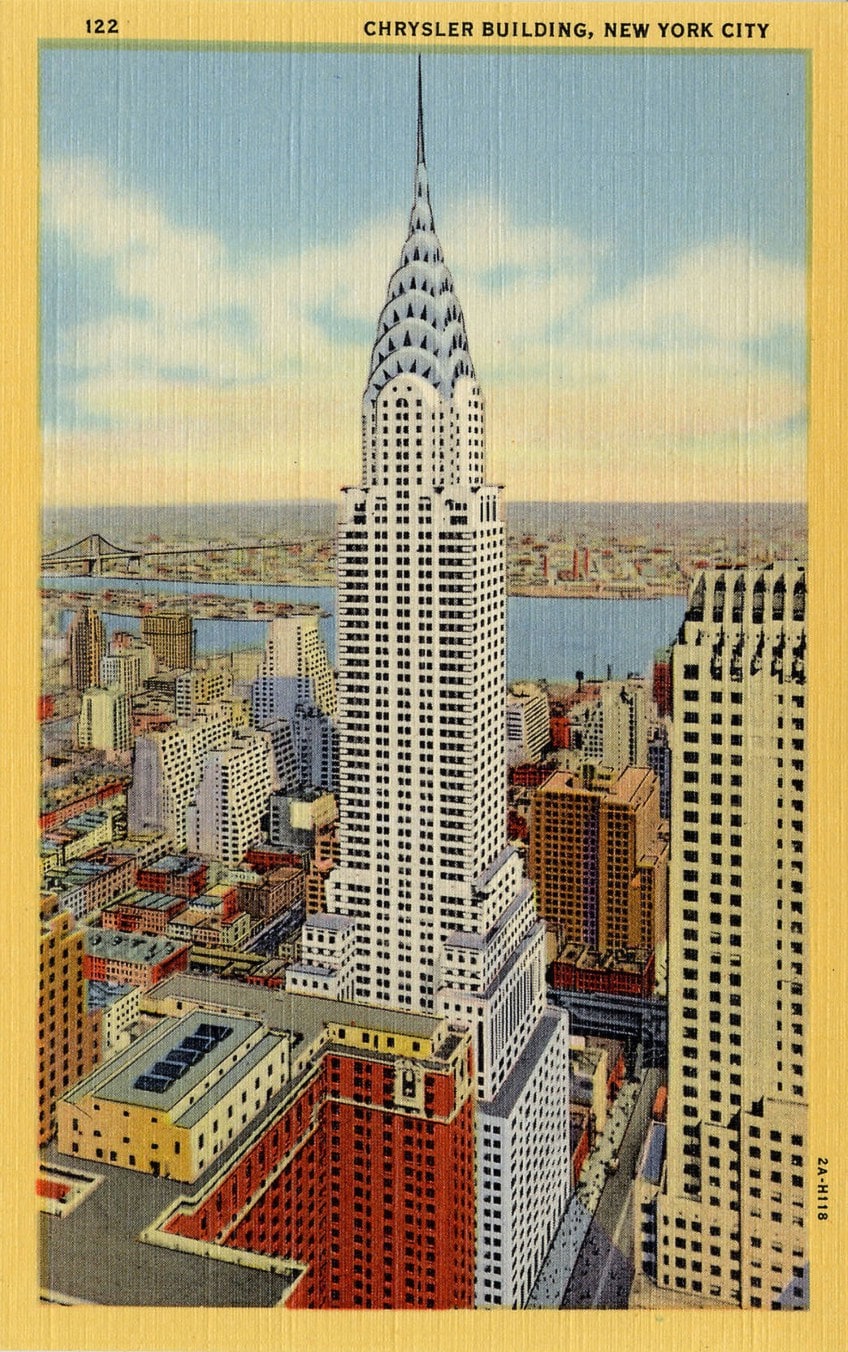 A postcard of the Chrysler Building, 1932;Unknown author Unknown writer, Public domain, via Wikimedia Commons
What made the Chrysler Building and so symbolic was its style of decoration. Triangles effectually the curved tiers adorned the tiptop of the building, with these shapes being placed in a way that copied the sun gleaming towards a top. Art Deco gargoyles were also featured equally ornamentation that closely imitated the hood ornament of a machine.
This gravity-defying skyscraper, as information technology was described at the time, featured all of the essential Art Deco building elements equally it invoked the modern man versus nature struggle in its architecture.
Key Accomplishments of Art Deco
As a modern style of creation, Art Deco attempted to alloy functional objects with artistic touches. This is one of the aspects that made Art Deco and then unlike from other fine art styles like painting and sculpture, every bit artworks had no other existent purpose or use beyond functioning as something intriguing for viewers to look at.
With the emergence of widespread manufacturing, Art Deco artists were able to amend the advent of their mass-produced functional objects so that they were accessible to anybody in lodge.
One of the biggest accomplishments of the Fine art Deco move was the fact that near everything could be seen as art, from something as simple every bit clocks, glassware, and ashtrays to more complex creations like cars and buildings.
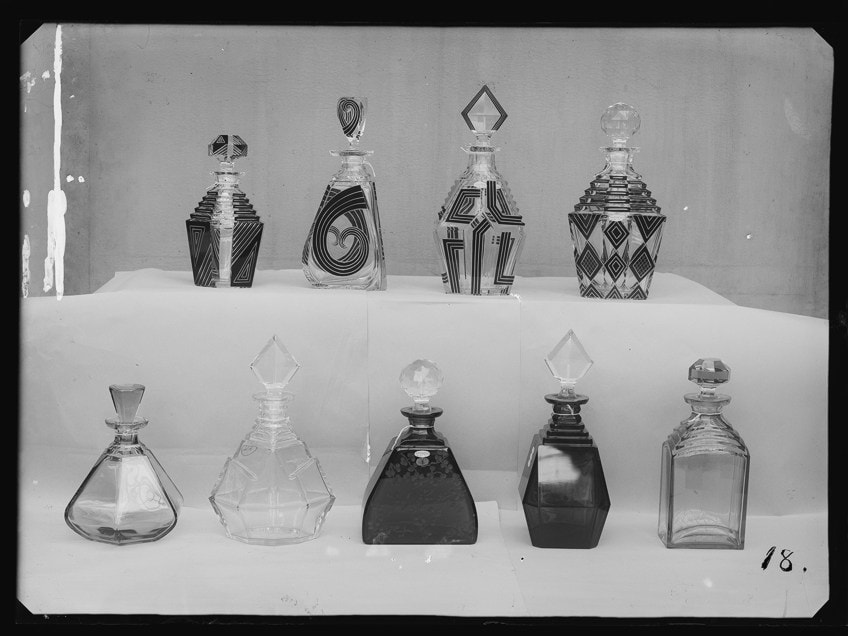 Art Deco-mode glassware, c. 1899-1930;National Library of Norway, Public domain, via Wikimedia Eatables
This demonstrated Fine art Deco'due south quest to find beauty in all facets of life, with the move's aim reflecting the considerable originality and mass usage of machine-age technology that existed at the time. Fine art Deco achieved this by focusing on the elegance and appeal of objects that already existed around us, with another accomplishment of the Fine art Deco era being its truly autonomous aim. Artists attempted to make even the plainest and unrefined objects, like car-made objects, as aesthetically pleasing as possible.
Art Deco in America
In America, the Fine art Deco movement was met with a completely different approach. Herbert Hoover, who was the Secretary of Commerce and so, stated that no American artists and designers were allowed to display their work at the Exposition International in French republic. This was because Hoover believed that they were yet to come upward with an explicitly American mode of art that was sufficiently "new enough".
In response to this, he sent a group to France to assess the artworks at the Exposition and to bring home any ideas that could be applied in a modernistic American artistic and architectural sense.
Within this traveling cohort, Hoover included important figures from the Metropolitan Museum of Art and the American Constitute of Architecture, equally well as several individuals from The New York Times. This trip to Europe went on to inspire an virtually instantaneous expansion in creative innovation and creation in the United States.
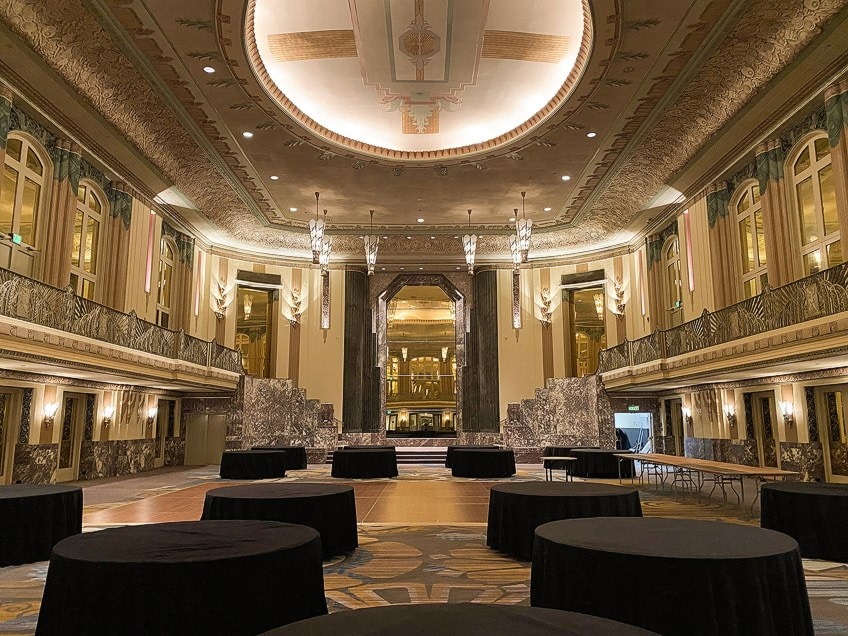 Art Deco-style Hall of the Mirrors inside the Carew Tower, Ohio;EEJCC, CC Past-SA 4.0, via Wikimedia Eatables
The American Fine art Deco style proved to exist quite different from the original style that developed in France. Nicknamed "Streamline Moderne", American Art Deco was a more diminished and sleeker version when compared to the complex and regularly bespoke European Art Deco manner.
Emphasizing the technological advancements of the era, American Art Deco quickly grew and expanded to have a far greater following and utilise in the United States than in Europe.
The presence of a unique Art Deco way helped to return some trust and belief in social progress in America, every bit the artworks that were created were thought to be an expression of national pride. The American Earth Fairs in Chicago (1933) and New York Urban center (1939) mainly featured Art Deco designs, as Hollywood adopted the style and made it alluring throughout the state. American Art Deco'south rapid growth created an expression of democracy through its designs, which were made accessible to ordinary citizens.
Belatedly Fine art Deco
By 1925, 2 completely unlike and contending schools coexisted inside the Art Deco movement. These schools were made upwardly of the traditionalists and the modernists. The traditionalists, who had originally established the Society of Decorative Artists, included article of furniture designer Emile-Jacques Ruhlmann, interior designer Jean Dunant, sculptor Antoine Bordello, and designer Paul Poirot.
This school of Art Deco was known for its combination of advanced forms with conventional techniques and pricey materials.
On the other mitt, the modernists stood out for their blatant rejection of the past. Artists within this Art Deco group sought to find and create an artistic manner that was based on new developments in technologies, simplicity, an absence of ornamentation, and the use of cheaper materials and mass production.
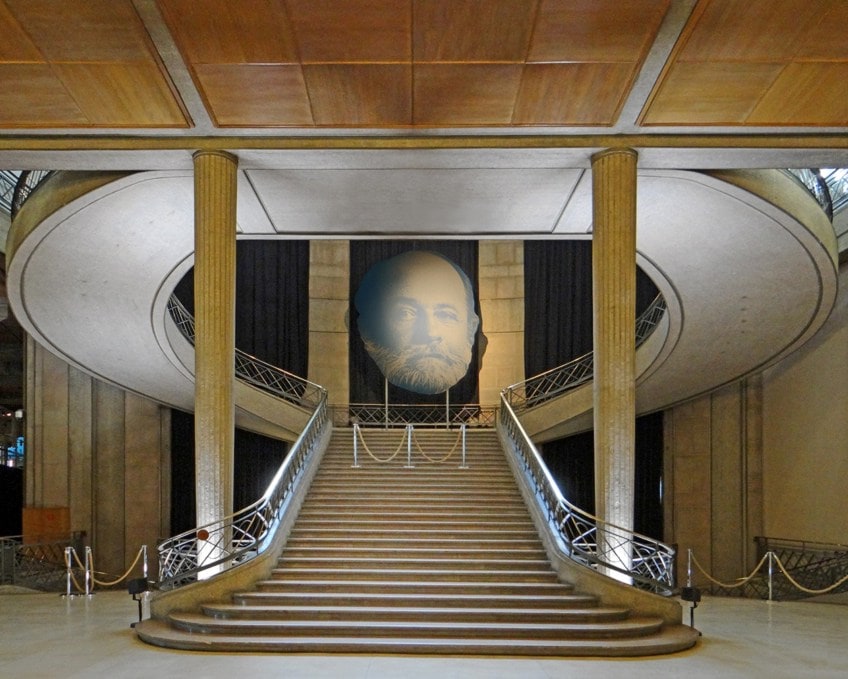 The portrait of Auguste Perret in the Art Deco-fashion one thousand staircase of the Palais d'Iéna, Paris, France. The staircase faces the entrance to the conference room, interim equally a hinge between the ends of the north and south wings of the Palace. Note that the reinforced concrete columns are tapered downwardly to limited "the structural nature of the fabric";Jean-Pierre Dalbéra from Paris, France, CC By 2.0, via Wikimedia Commons
The modernists established their ain organization in 1929, which was called the French Union of Modern Artists. Creatives within this group included Pierre Chateau, Francis Jourdain, Le Corbusier, and Sonia Delaunay.
The modernist Art Deco group criticized the traditional Art Deco style, which they formed was simply created to serve the wealthy.
This group argued that well-made buildings, for instance, should exist accessible and convenient to anybody no matter their fiscal status, and that class should automatically follow function. Based on this, the elegance and charm of an object or edifice rested upon whether it was perfectly capable of fulfilling its role and not related to the fine art audience who would near likely exist viewing the works.
Notable Fine art Deco Artists
Many artists participated in the Art Deco movement, ranging from painters, sculptors, interior designers, piece of furniture makers, and architects. Below, we volition exist taking a look at several notable creatives who created meaning artworks within the Fine art Deco menstruum and whose influence is still discussed today.
René Lalique (1860 – 1945)
French designer René Lalique has gone downwardly in history equally one of the globe'south most well-known drinking glass art designers from the late xixth and early 20thursday centuries. His legacy as an Art Deco creative person is still stiff today, with his glasswork pieces still highly favored by collectors. During his career, Lalique was best known for his beautiful perfume bottles, jewelry, vases, chandeliers, clocks, and car hood ornaments.
Lalique quickly became one of the most acclaimed Art Nouveau jewelry designers and went on to piece of work for prominent French jewelers like Cartier and Boucheron.
In the 1920s, after Lalique had refined his glass fine art creations, he rejected the style of Art Nouveau and expressed an interest in fluid and organic forms. This led to him embracing the techniques of the emerging Art Deco style, with his artworks becoming sleeker in the procedure. Lalique experimented with a variety of new materials, yet he preferred to work with glass.
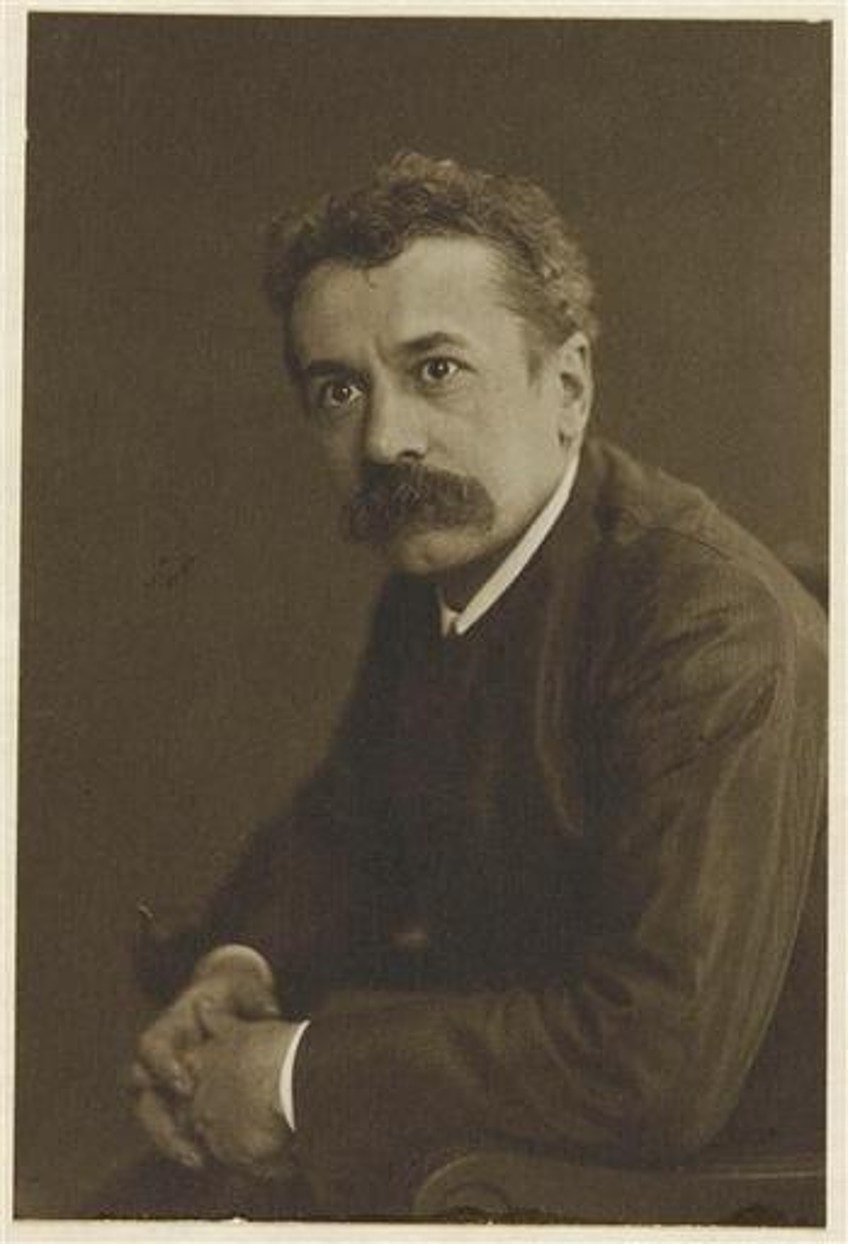 Portrait of René Lalique, 1906;Aaron Gerschel, Public domain, via Wikimedia Commons
As he adept within the Art Deco movement, his style of glassmaking dominated the jewelry industry. Lalique'south triumph was also credited to an older method of glass casting, which was rarely used up until this signal, and enabled him to effortlessly produce multiples of the same design. In add-on to his dainty perfume bottles and pieces of jewelry, some of Lalique's monumental Fine art Deco works include the walls of illuminated glass and glass pillars for the bounding main liner, Normandie.
Withal, one of Lalique's well-nigh well-known glass sculptures was "Victoire", which he created in 1928.
Made to be a glass hood ornamentation for a car, Victoire represents a female person figure in the wind. With her confront keenly sticking out and her pilus dangling backside her like a single, abrupt fly, this sculpture makes reference to the aboriginal Greek sculpture, Winged Victory, located in the Louvre. With Victoire existing every bit both fine fine art and a sculptural object, it seems to encapsulate everything that Art Deco was due to its truly American style.
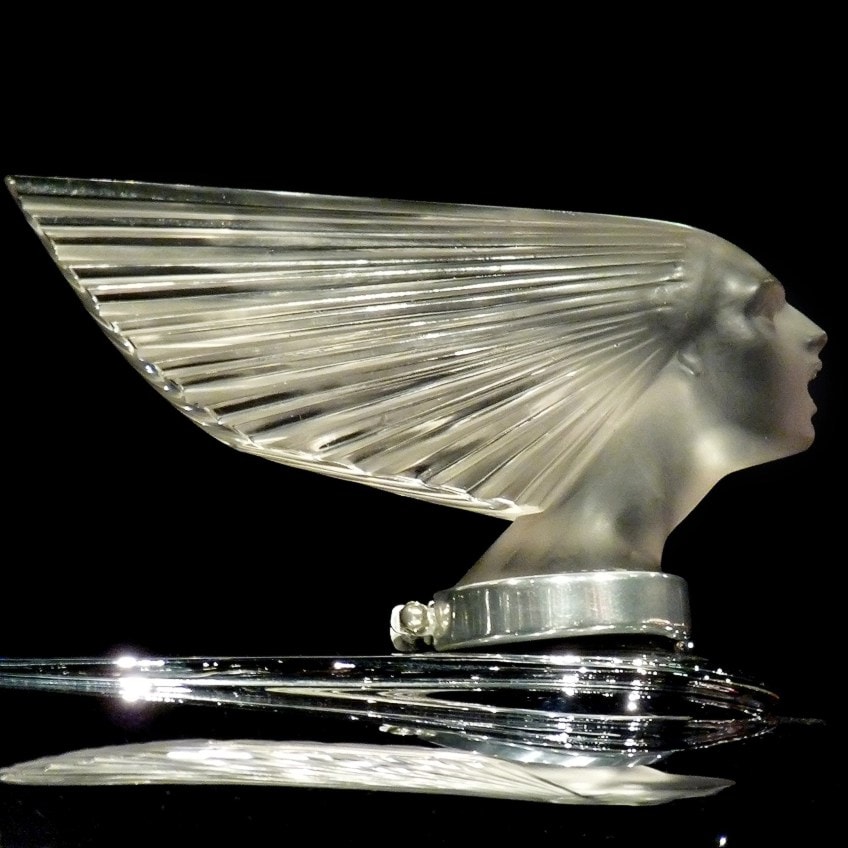 "Spirit of the Wind" or "Victoire" mascot by Lalique, 1928; Ingrid Taylar from Seattle, WA, USA, CC BY-SA 4.0, via Wikimedia Eatables
Émile-Jacques Ruhlmann (1879 – 1933)
One of the most prominent article of furniture and interior designers within the Art Deco movement was French creative person Émile-Jacques Ruhlmann. His furniture designs appeared to be incredibly streamlined, as he fabricated use of very extravagant and outlandish materials that he worked with using his exceptionally delicate craftsmanship. During the movement's height of popularity, Ruhlmann became a symbol of the opulence and contemporaneity associated with the Art Deco style.
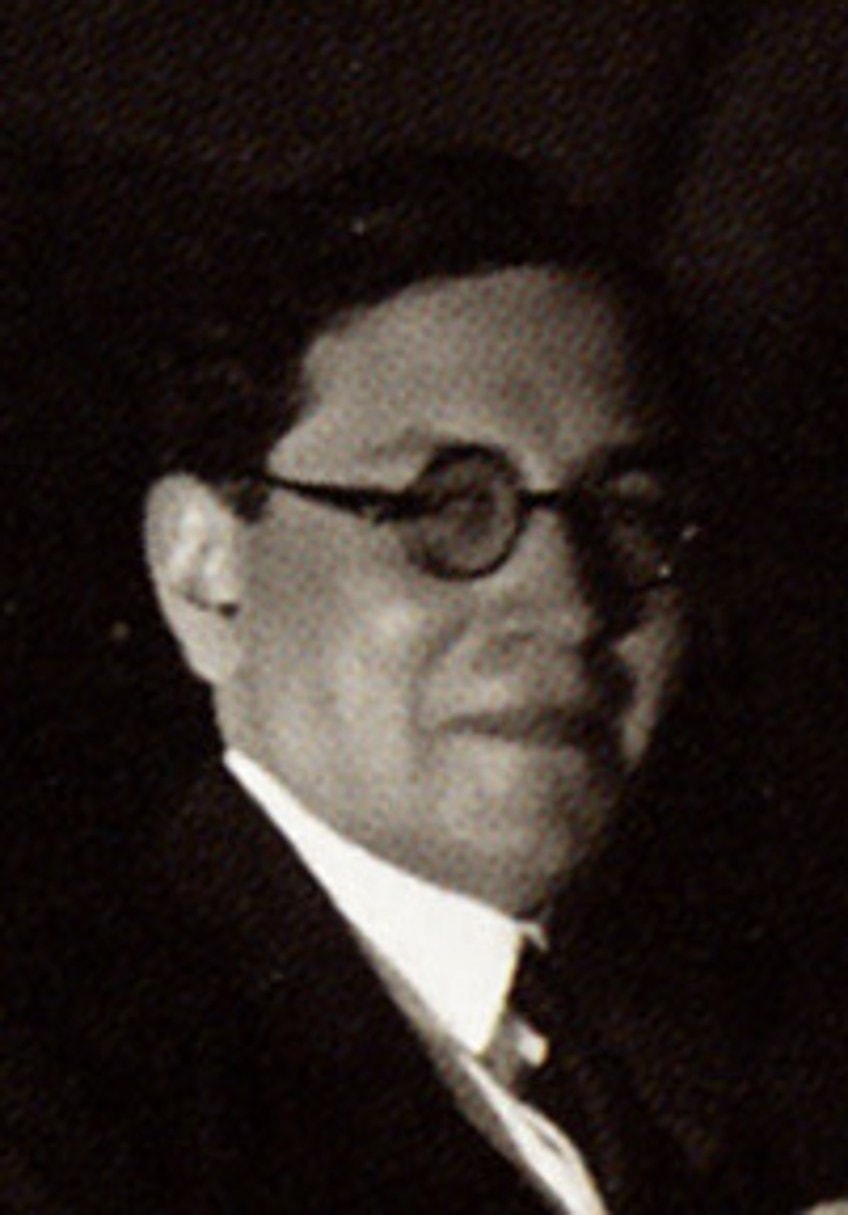 Émile-Jacques Ruhlmann, 1930s;Olivier Old, CC BY-SA 3.0, via Wikimedia Commons
Ruhlmann's lavish style produced unlike reactions from a number of different Fine art Deco designers and architects. Le Corbusier, in detail, responded to the types of artworks produced by Ruhlmann by calling for the creation of uncomplicated and more than practical furniture pieces instead. However, Ruhlmann strongly believed that the preservation of art relied entirely on the upper class, with his designs going on to perfectly capture the sensational and magnificent spirit of the time.
Although he was restrictive when it came to ornamentation, Ruhlmann fashioned his furniture pieces out of the most exotic materials at the time. As a firm favorite of the post-war conservative classes, Ruhlmann designed furniture that was able to display the newfound wealth and sense of taste of the recently emerging aristocratic society.
Due to this, the greatest accomplishment of Ruhlmann'southward career was said to accept been his power to merge the classical style of the past with the more advanced style of the modern world.
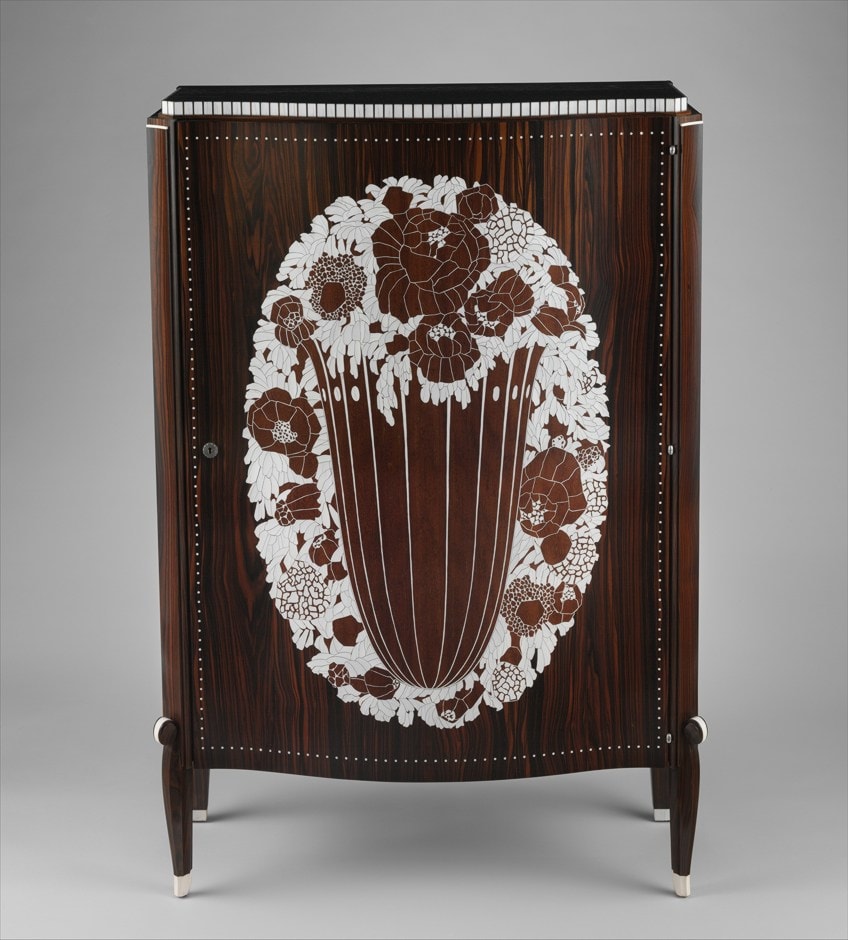 "État" Cabinet by Émile-Jacques Ruhlmann, 1922;Jacques-Émile Ruhlmann, CC0, via Wikimedia Commons
Ane of Ruhlmann's notable furniture pieces, produced in 1922, was État Chiffonier. Diverging from the typically Art Nouveau way in terms of its symmetry and restricted color palette, Ruhlmann made use of a strong woods that contrasted sharply against the intricate ivory design. Despite this, the elaborate floral features borrowed heavily from the Fine art Nouveau style, with État Cabinet existing every bit a more than updated and simplified object that seemed stuck between the two styles of Art Nouveau and Art Deco.
William Van Alen (1883 – 1954)
Perhaps the most important artist to come from the Art Deco period was American builder William Van Alen, who designed the iconic Chrysler Edifice in New York City. Born in Brooklyn, Van Alen went on to study architecture in both the U.s.a. and Paris before settling on a specific architectural style. In 1910, afterwards returning from Paris, Van Alen displayed his great interest in the style of modernism, which was said to take been inspired by the early stages of the still-developing Fine art Deco movement.
Many of the significant buildings in New York were built during the peak of the Art Deco movement. The famous Chrysler Building, which inverse the skyline of the city, was designed by Van Alen in the late 1920s, with the building being completed in 1930.
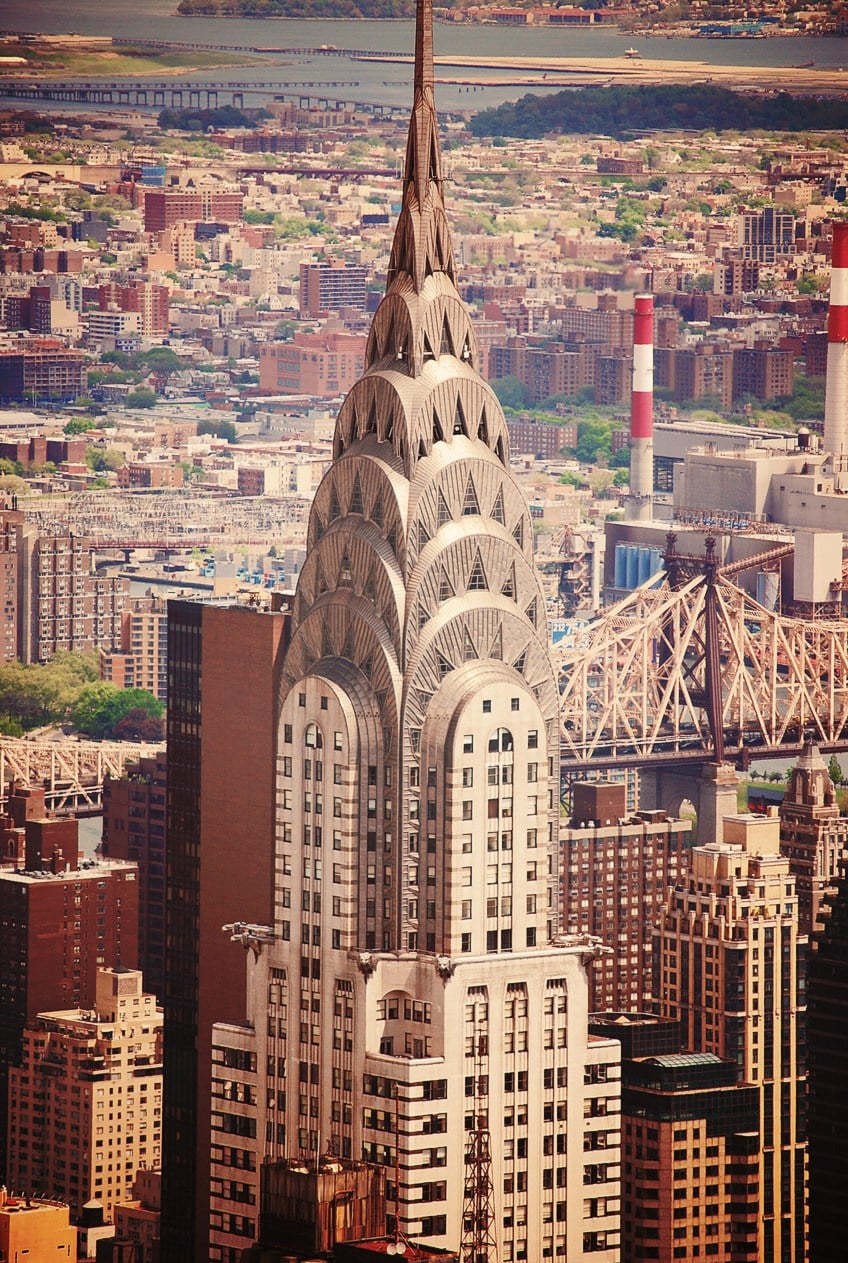 A photograph of the Chrysler Building, 2012; Fifty Latumahina, CC BY 3.0, via Wikimedia Eatables
Built in the Turtle Bay neighborhood on the East Side of Manhattan, the Chrysler Building is known for being one of the almost hit skyscrapers in the metropolis. This style of compages proved to be incredibly popular and connected to exist used well into the 1960s.
Completed in less than two years, it was said that approximately four floors were built each calendar week, which was a surprisingly rapid fast for the types of machinery that was available at the time.
Financed past Walter P. Chrysler, the building was designed to brand reference to Chrysler automobiles. Van Alen's original design used many modernist stylistic elements, such every bit curved windows at the corners. Ii of the well-nigh recognizable aspects of the building include the famous gargoyles, every bit well as the seven arched crowns at the top of the tower.
Sonia Delaunay (1885 – 1979)
One of the few female artists who practiced in the Art Deco motility was the Russian-born French artist Sonia Delaunay. Co-founder of the Orphism art motion, Delaunay is said to have been included with other notable Art Deco designers who however agree a strong influence over various way trends today. Inspired past the Cubist and Fauvist movements, Delaunay worked closely with boyfriend Surrealist and Dada artists while perfecting her fashion. This led to her becoming the first designer to bring abstract inspiration into the realm of mode.
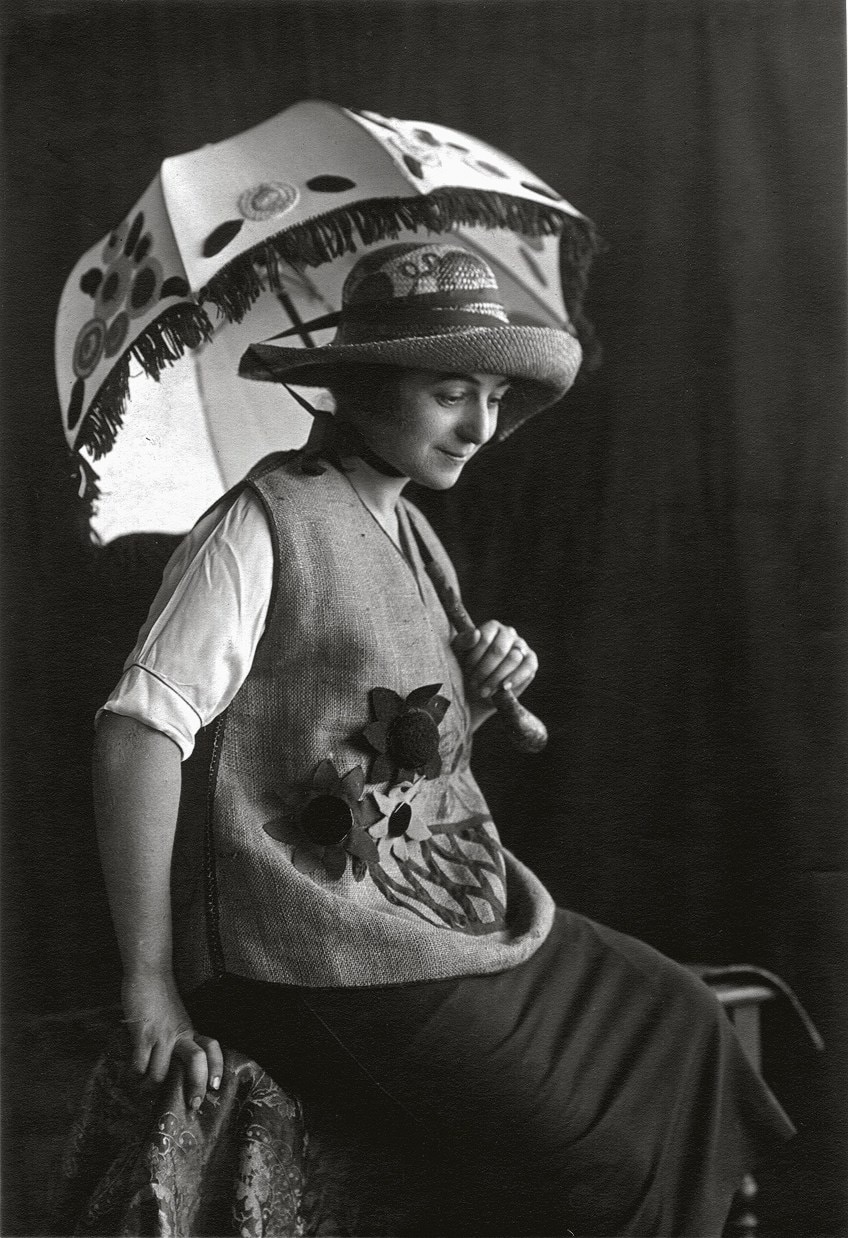 Sonia Delaunay wearing Casa Sonia creations, Madrid, c. 1918-1920;Anonymous Unknown author, perhaps by Zockoll, Public domain, via Wikimedia Commons
Delaunay was fascinated with the idea of geometric design, which proved to be mod and substantially fashionable between 1920 and 1930. As a textile designer, in addition to beingness a painter, Delaunay produced some of her nigh notable style pieces during this time. Color was a major aspect that featured in her works, which she defined as "dynamic fine art".
Delaunay's bold colour and textile combinations led to her title of "designer of modern fashion" during the 1925 Exposition in Paris.
Her almost well-known garment is mayhap her patchwork dresses, which existed as experimentations of "simultanism". Mixing a variety of colors and materials, Delaunay made use of unlike bold blocks of color and loud geometric shapes, which made her dresses stand out. Her success in way is partly due to her liberation of the silhouette in female person clothing after World State of war One, with her creations and art still influencing modern fashion houses like Christian Dior and Yves Saint Laurent today.
Tamara de Lempicka (1898 – 1980)
Some other very of import female artist who produced artworks during the Art Deco period is Tamara de Lempicka. Possibly one of the most respected and recognizable artists to emerge from the Art Deco movement, Polish-born Lempicka was best known for her refined and trendy Art Deco depictions of the wealthy class and her incredibly stylized paintings of nudes. Settling in Paris after the Russian revolution, Lempicka became fascinated with the nonconformist Parisian lifestyle that existed in the 1920s.
Lempicka's portraits brought her critical praise and significant wealth. Her mode of painting perfectly depicted a lifestyle of luxury and glamour, with inspiration existence taken from other movements like Cubism.
Her unique approach to Fine art Deco painting allowed her to nowadays works that were both improvident nonetheless make clean and precise in nature. The boldness of Lempicka's colors and her angular style referenced some of the principal features of the Art Deco manner, which has led to her works being seen as the best representation of Art Deco painting.
Amid her iconic works include Young Lady with Gloves, which was painted in 1930 and exists every bit one of her best-known works. Depicting a fashionably pocket-size lady in a green dress, further emphasized past her subtly matching white hat and gloves, her brilliant red lipstick makes her stand out despite her credible timidness.
The sharp, almost fractured planes of color that were used to depict the facial features and the dress fabric exist every bit Lempicka's signature style, which also demonstrates the interplay of Cubism and Art Deco on her artistic style.
Today, Lempicka's portraits and paintings are still greeted with the same amount of enthusiasm every bit they were earlier. While her artworks were originally intended for an elite audition, they take sparked debate beyond all classes of society and are favored by many. Lempicka was considered to exist ane of the almost prominent portrait painters of her generation, with the clean lines and sleek elegance of her artworks existing as perfect examples of the Art Deco mode.
The Legacy Left by Art Deco
The same characteristics that made the Art Deco movement so pop in the beginning, such as its exquisite adroitness, rich materials, and ornamentation, somewhen led to its decline. The Nifty Low, which began in 1929 in the United States and reached Europe before long after, began to slowly foster a sense of deterioration in the fine art movement.
This devastating economic accident greatly reduced the number of flush clients who could afford Art Deco furnishings and objects at the fourth dimension, which led to the way rapidly dwindling.
The emergence of World War Ii seemed to signify Art Deco's falling from grace. During the wartime years, the restraint of society caused the Art Deco style to seem even more than decadent than it already appeared to exist, which was ill-fitting in a time of history that was so solemn. The limited supply of metal that could be recovered was used in building military weapons and equipment instead of decorating buildings and interior spaces. In a social club that was so grave at the time, objects like piece of furniture were no longer seen as important status items.
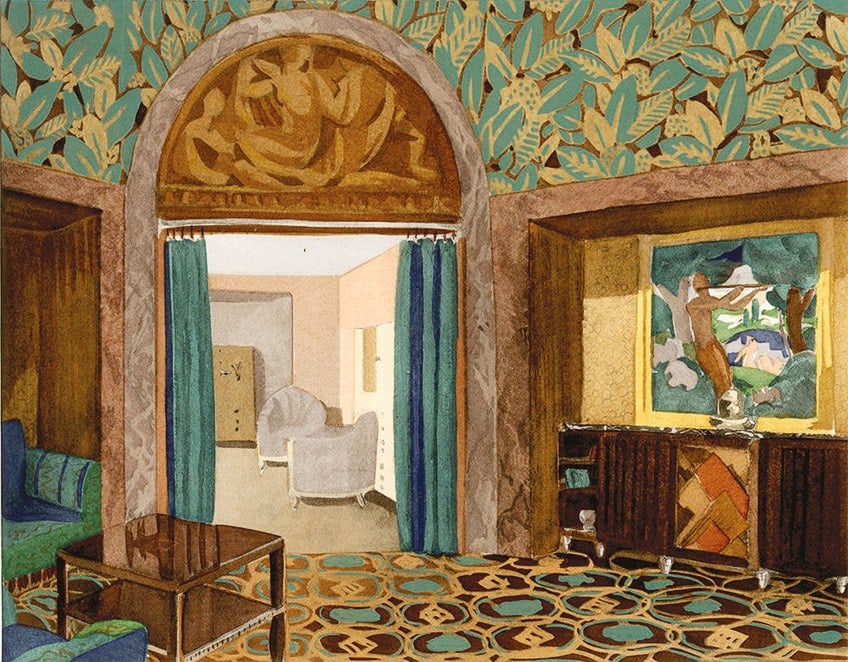 Art Deco-style French Embassy, Plate 22 (later on a watercolor by R. Crevel): antechamber by Paul Follot, painted panels past René Crevel, 1925;René Crevel, CC0, via Wikimedia Commons
Additionally, the crash of the stock marketplace in 1929 redirected the Art Deco movement towards the concept of mass production. Several technological advancements allowed for more than affordable production of bones consumer items, which drove out the need for and subsequent popularity of the existing Art Deco designers. By the early 1930s, Streamline Moderne developed in response to the Art Deco ideals within America, with this new fashion focusing on the simplification of designs in objects, article of furniture, and architecture.
Fine art Deco experienced a revitalization during the 1960s with the beginning of the consumerist culture. Since so, a steady and continued interest in the Art Deco movement can be seen in the various fine art styles and designs that have emerged, which all seem to comport hints of the streamlined aesthetic of Deco art. Despite Fine art Deco developing as a move that aimed to escape the past, it has now get a sentimental and addicted memory of a classical style that has proven to be inseparable from the past.
As an art style that nevertheless has implications today, the development of Art Deco pattern has truly been remarkable. Despite being popular near a century ago, Art Deco was considered to be one of the offset styles of modern compages to actually make an impact on the art world. Today, inspiration is still being taken from this quintessential mode, which has allowed this decorative type of art to essentially come back into manner once more. No matter how much time has passed, Deco fine art's striking geometric shapes will forever remain iconic.
Take a look at our Art Deco manner webstory here!
Oft Asked Questions
What Is Art Deco?
Art Deco, which emerged onto the art scene in the early 1920s, was an art style defined past its fascination with modernity. This idea could be seen through the elements of vibrant colors and bold geometric patterns that were used, as the aim was to create lavish and truly opulent artworks. Art Deco is also most famously known for its contribution to architecture.
What Are the Main Characteristics of the Art Deco Style?
The main characteristic of the Art Deco way was its pure admiration for the concept of modernity, also every bit its respect for the advocacy of machinery and applied science. Elements that were able to emphasize simplicity, repetition, and symmetry were oft used, which allowed Art Deco artworks to appear with a clean and streamlined aesthetic.
What Are Some of the Most Iconic Art Deco Pieces Made?
Fine art Deco architecture has proven to be the most pregnant genre of the fashion, as information technology has produced some of the virtually well-known mod buildings to date. These include Rockefeller Centre, the Empire State Building, and the admittedly breathtaking Chrysler Building, all built in New York City.
costellothentorcip.blogspot.com
Source: https://artincontext.org/art-deco/
0 Response to "What New Style of Art Was Developing During the 1730s"
Post a Comment