The Art of Change and the Act of Social Justice
Social justice fine art, and arts for social justice, encompasses a wide range of visual and performing art that aim to raise critical consciousness, build customs, and motivate individuals to promote social alter.[1] Art has been used as a ways to record history, shape civilization, cultivate imagination, and harness private and social transformation. Information technology can not simply be a means to generate sensation, but it can also exist a catalyst to engage customs members to take action around a social issue.
Social justice art allows people to develop agency to interrupt and change oppressive systemic patterns or individual behaviors.[2] The processes by which people create and engage with art equips them with analytic tools to sympathize and challenge social injustices through social justice education (teaching for social justice), customs building, and social activism/social movements.[iii] Examples of visual and performing social justice fine art includes: cartoon, painting, sculpture, murals, graffiti, motion picture, theater, music, dance, spoken word, etc.
Background [edit]
Art has played a part in social justice education, community building, and social activism/social movements. It provides a universal language that gives vocalism to individuals and communities and is accessible beyond social boundaries. These examples can overlap and are not strictly confined to 1 specific category.
History [edit]
2 well-known art movements that accept utilized art equally a ways to work towards social justice are the Blackness Arts Movement and Chicano art movement. Both movements began to enter into public consciousness during the 1960s. The Civil Rights Movement in combination with the Blackness Power Movement helped to propel the Black Arts Movement. One of the main goals of this motility was to support Black Nationalism and mobilize the customs towards social action. This flow produced an increase in Black verse, literature, and music. A few key figures of the movement were; writer Marcus Garvey, writer and artist Charles S. Johnson, revolutionary creative person Emory Douglas, and social dancer and choreographer Katrina Hazzard-Gordon.[4] The efforts to contain mail-Mexican Revolution notions with current Mexican American social, political, and cultural issues drove the Chicana/Chicano Arts Movement. Murals are a form of visual art that experienced a rise in popularity during this movement. Chicana/Chicano mural art became a means of working towards political goals, challenging stereotypes, every bit well as a style for customs members to play an active role in creating community memoirs. Diego Rivera was i prominent effigy who helped to establish Mexican muralism.[v]
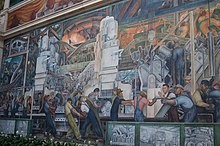
Diego Rivera - Detroit Industry Murals
[edit]
Social justice teaching is an educational approach that focuses on fostering awareness of social injustices and how inequalities touch youth.[6] Social justice teaching saw its roots in the ideas of Paulo Freire, author of Pedagogy of the Oppressed. In his work, Freire highlights the theoretical ideas of critical pedagogy, which is an approach that combines education and disquisitional theory. This approach is relevant to social justice art education considering it combines the critique of social injustices and the utilise of art equally a mechanism to engage with social issues.[seven]
Culturally relevant arts education [edit]
Culturally relevant arts education (CRAE) is an educational activity model that emerged from the Tubman Theater Project, a culturally relevant drama program in which African American middle and high school students examine their internalized oppression and work to create positive racial identities. The program gives them the opportunity to acquire from rehearsing and performing plays based on their lived experiences. This framework incorporates six dissimilar pedagogies. Three of these are art related; arts production, aesthetics, and arts integration as well as three non-art related; multicultural education, critical pedagogy, and contextual teaching and learning. CRAE engages both students and educators in a process in which they reflect on their social position in societal liberation and subjugation.[8]
In college education [edit]
Several universities have introduced social justice arts programs:
- University of San Francisco - Performing Arts & Social Justice Major[9]
- Santa Clara Academy - Arts for Social Justice[10]
- University of Michigan - The Prison Creative Arts Projection[xi]
[edit]
Sense of customs is congenital through bridging geographic or interest-driven relationships. Building community helps individuals come together to claiming inner oppressive dynamics that have been imposed by institutions, structures and bodies. These inner oppressive dynamics have been termed "social ghosts" have been referenced in trip the light fantastic literature and function as a fundamental theme within many community edifice art projects. Art for community building is a collective effort in which the art making process strengthens community ties.[12]
- AIDS Memorial Quilt

- Oral History
- Mural Art
-

The Metropolis of Philadelphia Landscape Arts Plan
-
- Trip the light fantastic
- Martha Graham Trip the light fantastic toe Company's 'Political Dance Project'
- Karen Jamieson's Carnegie Trip the light fantastic toe Troupe
- Theatre
- In the Heart of the Beast Puppet and Mask Theater
- Theater of the Oppressed
- The Pride Youth Theater Alliance
- People's Theatre Project- Social Change through the Arts
- Photovoice
- Photovoice Projects
- Detroit Youth Passages Photovoice Project
- Heidelberg Project

[edit]
- Black Move
- Amiri Baraka
- Blackness Arts Repertory Theatre
- Feminist Movement
- Rosie the Riveter
- Chicana/Chicano Move
- La Raza
- Dia De Los Muertos
- Depression Passenger Art
- LGBT Rights and Gay Liberation
- AIDS Memorial Quilt
- Allen Ginsberg
References [edit]
- ^ Bell, Lee; Desai Dipti (August 10, 2011). "Imagining Otherwise: Connecting the Arts and Social Justice to Envision an Act for Modify: Special Issue Introduction". Equity and Excellence in Teaching. 44 (3): 287–295. doi:x.1080/10665684.2011.591672. S2CID 143144889.
- ^ Hanley, Mary (August x, 2011). "You Better Recognize!: The Arts as Social Justice for African American Students". Equity & Excellence in Education. 44 (3): 420–444. doi:10.1080/10665684.2011.589763. S2CID 143685912.
- ^ Roberts, Rosemarie (August 10, 2011). "Facing and Transforming Hauntings of Race Through the Arts". Equity and Excellence in Pedagogy. 44 (3): 330–347. doi:10.1080/10665684.2011.591260. S2CID 144645792.
- ^ Martin, Tony (1983). Literary Garveyism: Garvey, Blackness Arts, and the Harlem Renaissance. Dover, Massachusetts: The Majority Printing. pp. i–viii. ISBN0-912469-00-v.
- ^ "Chicanoart.org The Road to Mictlan". Webpage . Retrieved xiii March 2014.
- ^ Frank, Curkovic. "Art and Social Justice Instruction Part i". blog . Retrieved February xx, 2014.
- ^ Garber, Elizabeth (2004). "Social Justice and Art Educational activity". Visual Arts Research. 59. 30 (2): 4–22.
- ^ Hanley, Mary (Baronial ten, 2011). "You Better Recognize!: The Arts every bit Social Justice for African American Students". Disinterestedness & Excellence in Education. 44 (iii): 420–444. doi:10.1080/10665684.2011.589763. S2CID 143685912.
- ^ "CAS - Performing Arts - Performing Arts & Social Justice Major - Academic Plan". 27 July 2015.
- ^ "Arts for Social Justice | SCU Presents".
- ^ "Prison house Creative Arts Projection | U-M LSA Prison house Creative Arts Project".
- ^ Lawton, Pamela (November 2010). "Hand-in Mitt, Building Community on Mutual Ground". Art Education. 63 (6): 6–12. doi:10.1080/00043125.2010.11519096. S2CID 150733070.
External links [edit]
- Music and Social Justice article in the Internet Encyclopedia of Philosophy
Dewhurst, Marit. "Where Is the Action? 3 Lenses to Analyze Social Justice Art Instruction." Equity & Excellence In Education, vol. 44, no. 3, 1 Jul. 2011, pp. 364 - 378. Buller, Rachel Epp. "Activism, Art, and Design: Bringing Social Justice to Life In the Higher Education Curriculum." Art Pedagogy, vol. 74, no. 1, 1 January. 2021, pp. 31 - 37.
costellothentorcip.blogspot.com
Source: https://en.wikipedia.org/wiki/Social_justice_art
0 Response to "The Art of Change and the Act of Social Justice"
Post a Comment