how to draw a 3d face on paper
In this lesson, we'll wait at how to describe a face and we'll encompass several approaches. We'll begin past exploring the process of drawing a confront from the frontal view. In these series of steps, nosotros'll cover the full general locations of the facial features and learn a few proportional comparisons that you can use to ensure that your facial features are in the correct location.
Many people make mistakes when drawing faces considering they don't fully understand facial proportions. Proportion refers to the relationship in size and placement betwixt i object and some other.
At that place are many formulas that one can adjust to draw the facial features in the correct location. In that location's a simple approach - one that I first learned and is great for beginners. And then there is the more complex approach using illustrator, Andrew Loomis' guidelines.
How to Depict a Face from the Front - Step Past Footstep
We'll starting time discuss Loomis' approach, which is more than circuitous, but more authentic. If yous discover that this approach is a chip difficult for you, you tin can skip to the simpler approach further down the page. Recall, either style, the goal is to create a convincing cartoon of a face then either approach you take is fine.
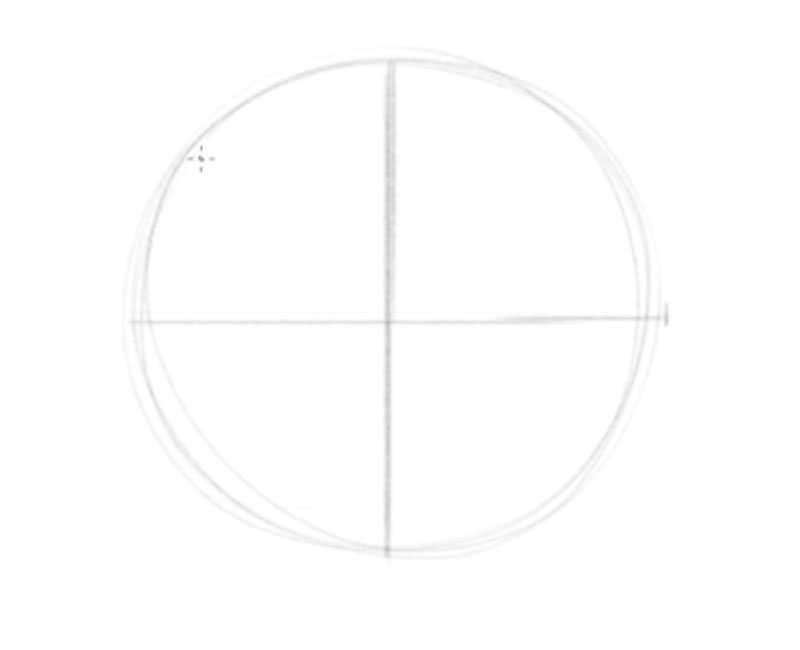
Footstep 1 - Draw a Circle and a Cantankerous
We'll kickoff describe a circle with two intersecting lines that connect directly in the center. The circle represents the peak portion of the head. We'll use the intersecting lines to determine the locations of the facial features.
Step 2 - Draw a Foursquare within the Circle
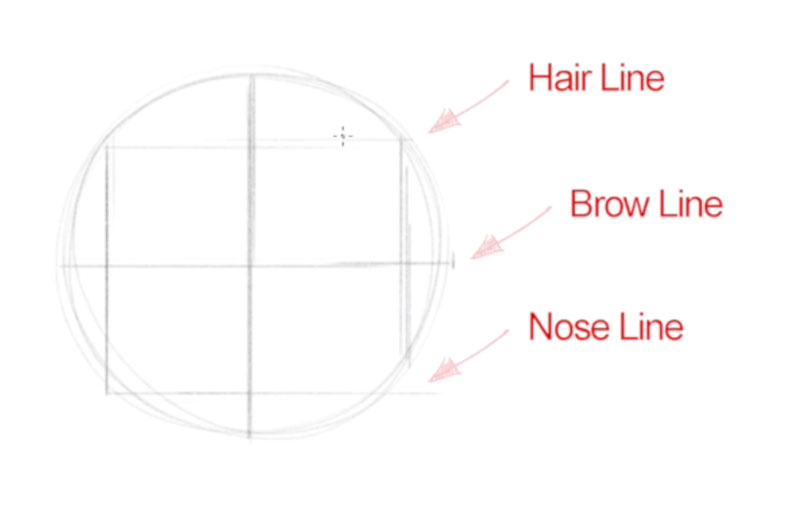
Next, we'll draw a foursquare in which each corner touches the circle. This square will somewhen represent the edges of the face. The elevation line will eventually get the lesser hairline. The bottom line will go the nose line, while the center line will become the brow line.
Pace 3 - Depict the Chin
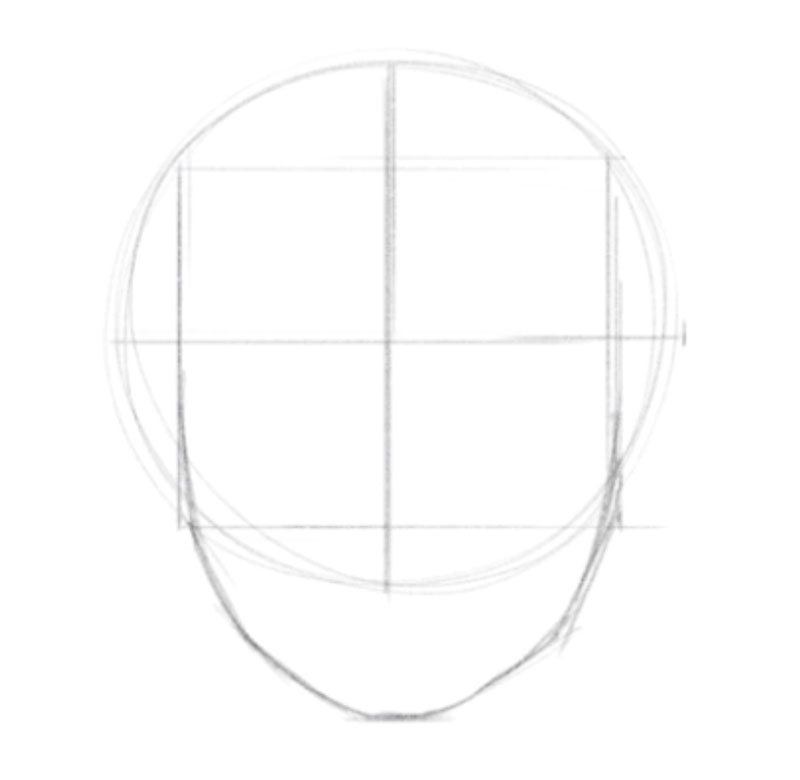
Now we'll measure the distance from the center line to the bottom line. Y'all can use your pencil to do this. From the lesser line of the foursquare, apply this measurement to mark the location of the bottom of the chin. Then, describe the edges of the chin from each side of the square and so that they connect at your marked location.
Step 4 - Locate the Eyes
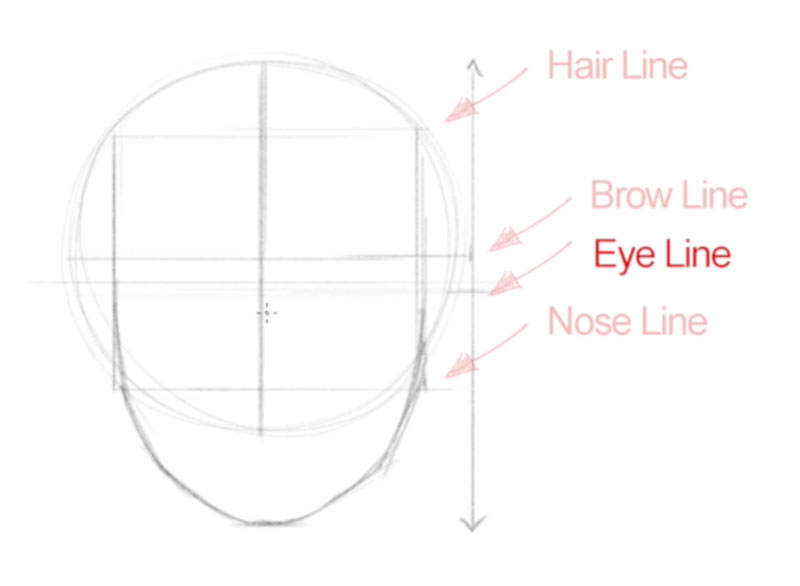
At present we accept the basic structure of the shape of the face in identify. We'll next locate the eyes. Nosotros tin can utilize the elevation of the head to help us determine the location of the eyes on the face. The eyes are generally institute on a line in the centre of the head.
The brow line is represented by the center line that we drew in stride one. So we know that the optics should be found simply below this line, in the center of the caput. Nosotros can describe a line here for the "middle line".
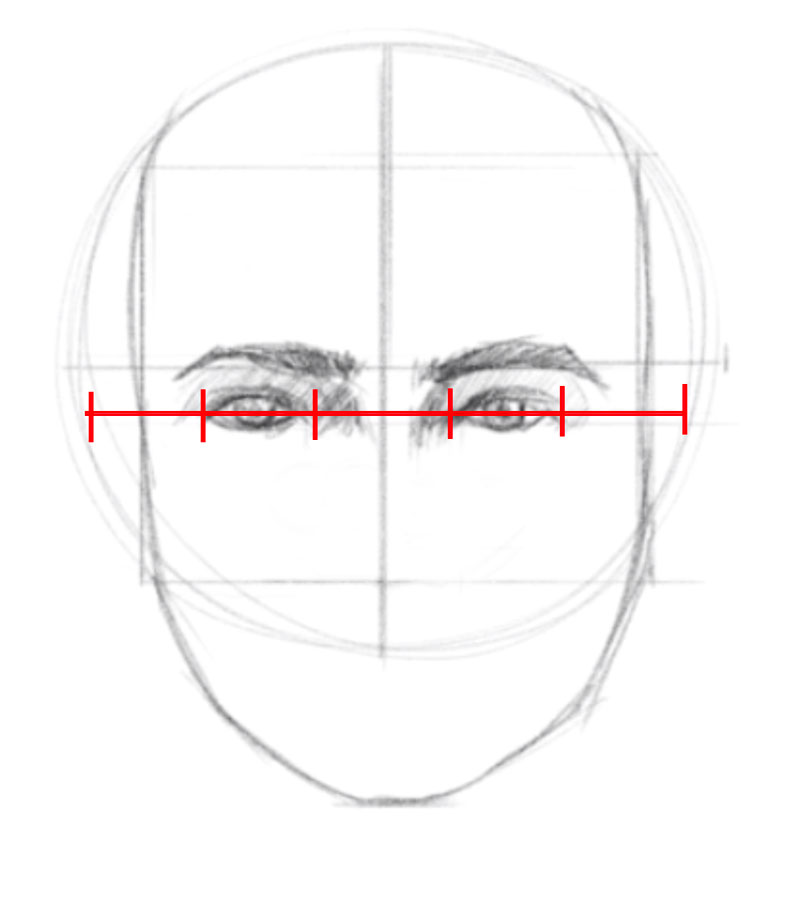
Step 5 - Draw the Optics
Now that nosotros know where our optics are located on the face, we can draw them. There's another measurement to keep in mind. Nosotros also should consider the width of the eyes. The width of the caput, from ear to ear, generally measures the same length of five "eyes". This ways that if nosotros want to draw the eyes with authentic proportions, then we demand to draw them so that they match this approximate measurement.
Footstep 6 - Locate and Draw the Nose
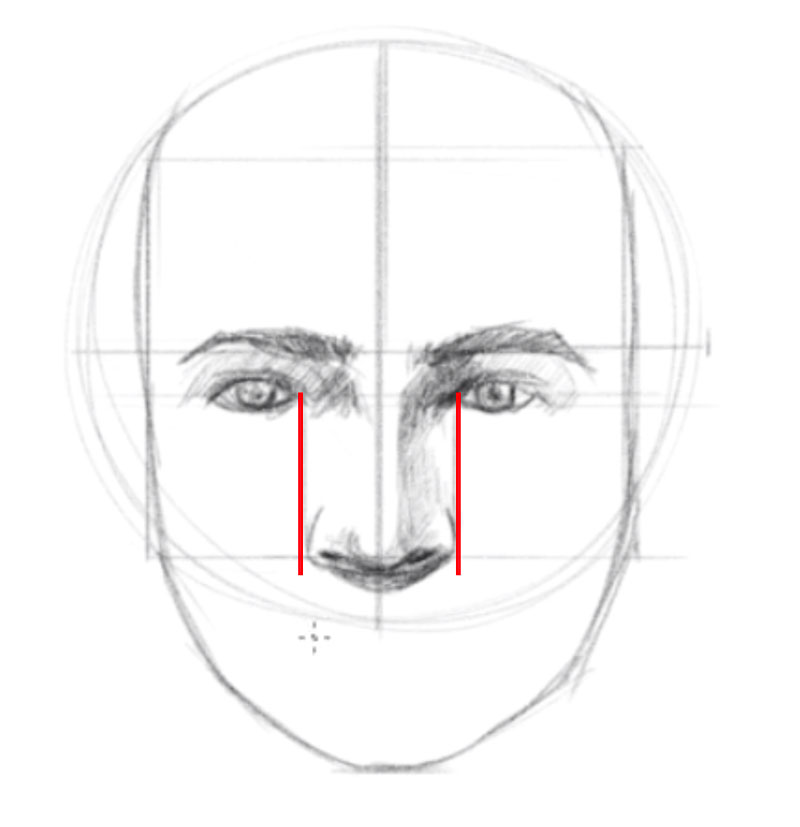
Moving down the face, we'll next draw the nose. The lesser of the nose tin can exist found on the lesser line of the square that nosotros drew in stride two. The width of the olfactory organ varies from person to person, but is generally as wide as the within corners of the optics.
It may exist helpful to draw two low-cal lines down from the inside corners of the eyes to help you observe the width of the nose.
Step 7 - Locate and Draw the Mouth
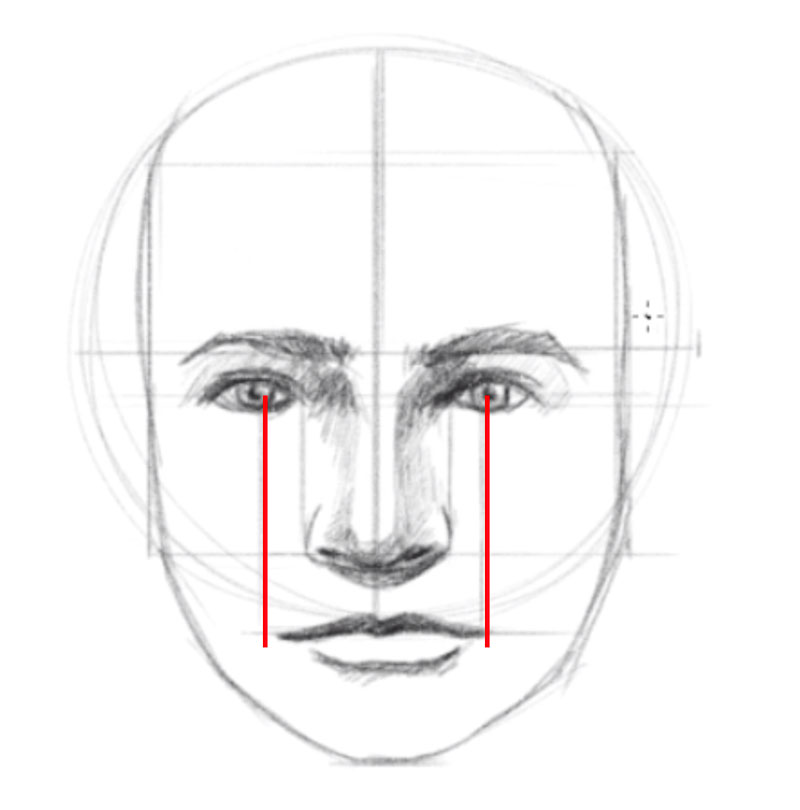
We observe the mouth slightly college than one-half-way between the bottom of the nose and the chin. Of course, this measurement varies from person to person. Nosotros can draw a line to marker the positioning of the mouth.
We can utilise the optics to help u.s.a. determine the width of the mouth. The corners of the mouth more often than not align with the inside edges of the pupils. It may be helpful to draw low-cal lines from the pupils to the "mouth line".
Step 8 - Depict the Ears
Next, we'll draw the ears. Here once again, we can use the locations of the features of the face to aid usa determine the location of the ears. The height of the ears will generally align with the brow line, while the bottom of the ears marshal with the nose line.
Go on in heed that the ears come up out of the caput and extend upwardly slightly. This means that the ears will extend outward from the head, near the eye line.
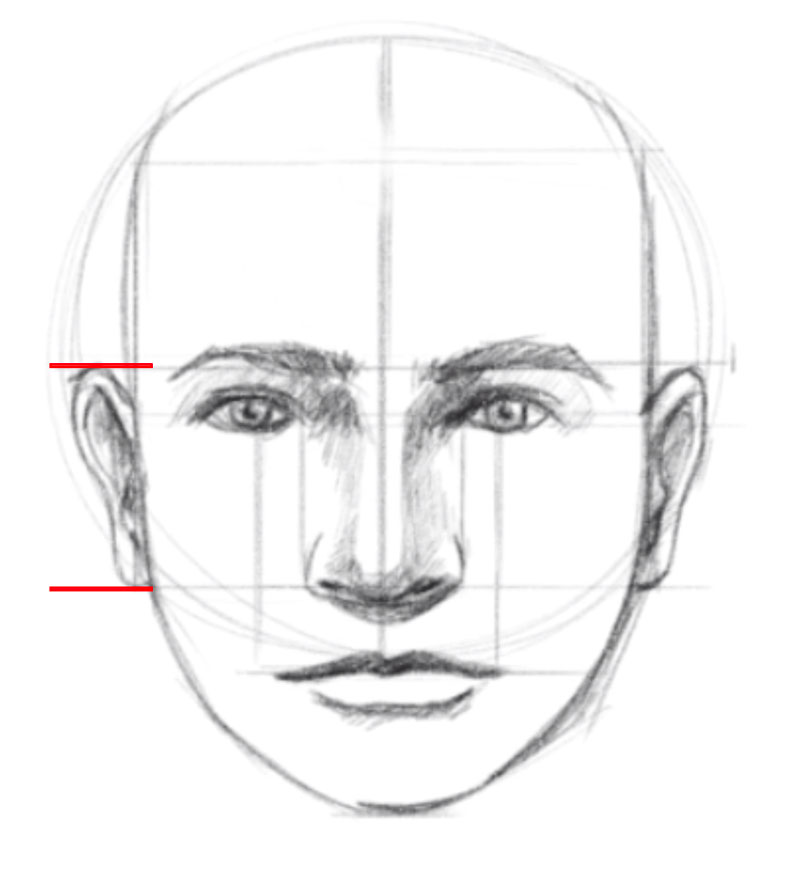
We've only sketched in a couple of loose ears for this lesson. If you want to take a closer wait at drawing an ear, cheque out this lesson...
- How to Draw Ears
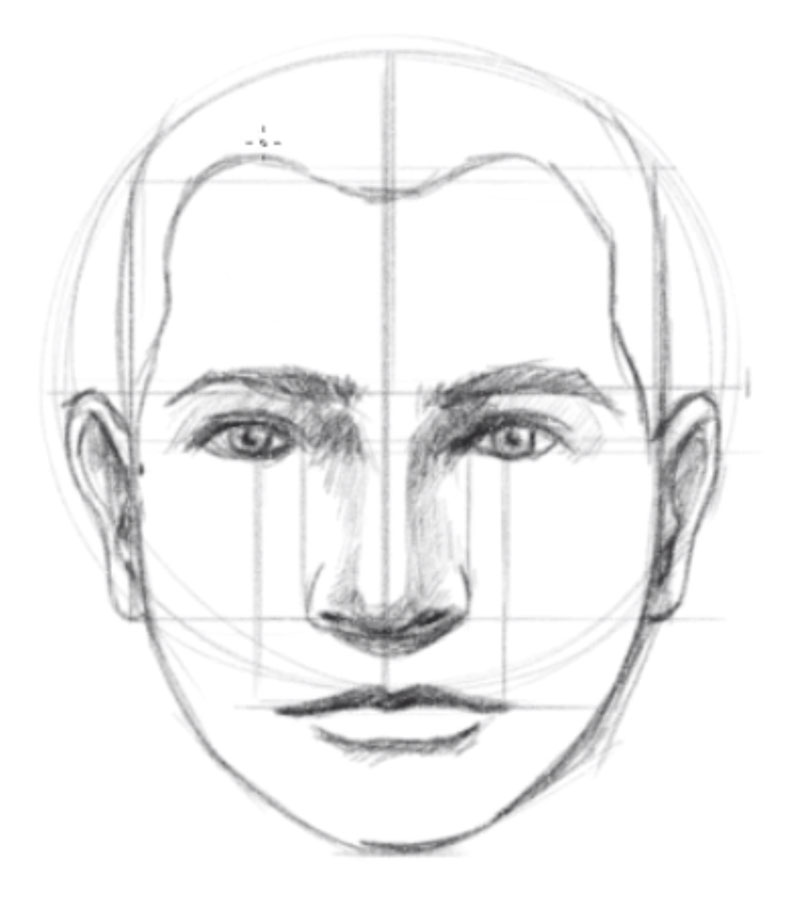
Step ix - Describe the Hairline
Now nosotros'll describe the hairline. If you're drawing someone that has long pilus that overlaps the forehead, the hairline may not be visible, just it'south still important to know where information technology's located. The hairline is constitute on the peak edge of the foursquare that we drew in pace 2.
Hairlines vary greatly from person to person. In this example, nosotros'll draw a widow's peak design.
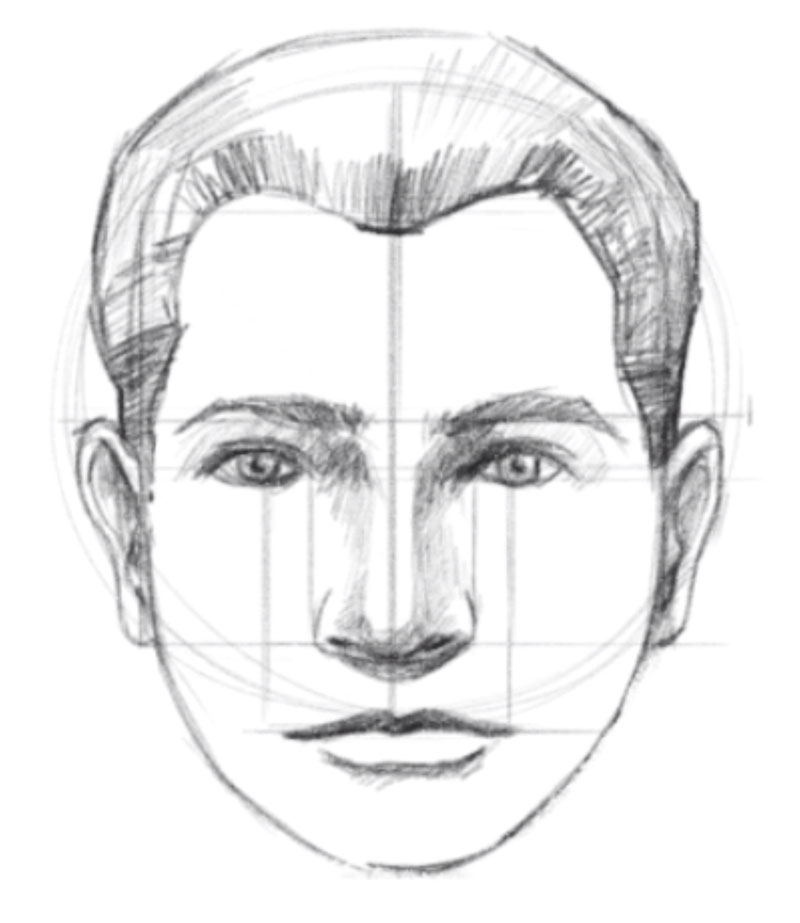
Step 10 - Draw the Hair
At present that nosotros have the hairline in place, nosotros can describe the pilus. Shorter hair extends only slightly off of the top of the head, while longer or bushier pilus may extend quite a scrap. In both cases, however, the pilus extends out from the caput and should non be fatigued directly on the caput.
Want more than education on drawing pilus? Check out this lesson...
- How to Draw Pilus
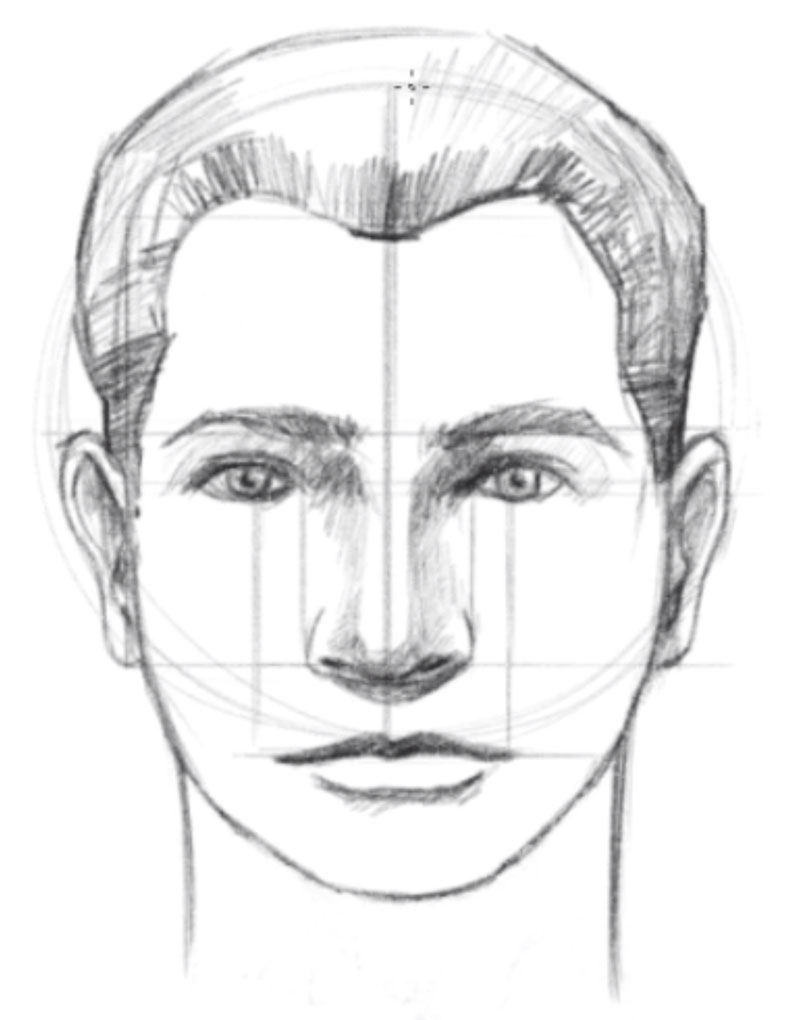
Step 11 - Add the Cervix
Now we demand to add together a cervix to our floating head. The tendency of nearly offset artists is to make the neck too narrow. Generally speaking, the cervix extends down from the bottom of the ears. Female person necks are slightly more slender, while the necks of males are broader.
To draw the neck, nosotros'll simply extend two lines down from the bottom of the ears.
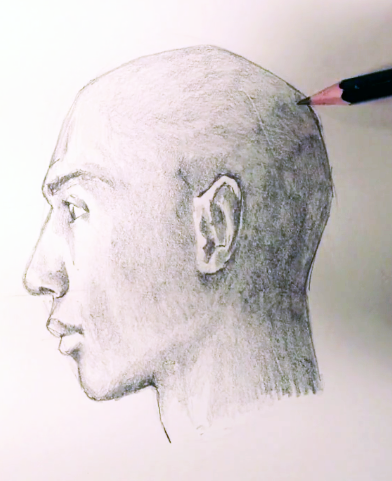
How to Draw a Face From the Side (Contour)
If you lot desire to depict a face up from the side or profile view, these aforementioned proportional measurements utilise. Nosotros'll simply alter the location of the features, positioning them on the side of the caput.
In fact, nosotros tin start the process in exactly the aforementioned way - starting with a circle with intersecting lines.
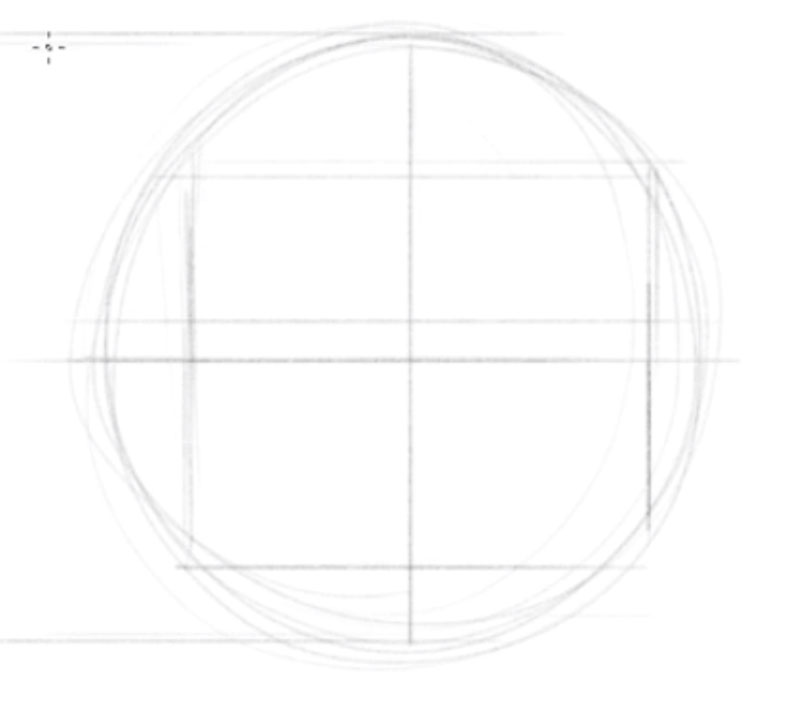
Step 1 - Draw a Circle, a Square, and Intersecting Lines
We'll commencement in the same way that we did before by cartoon a circumvolve, two intersecting lines, and a square that makes contact with the circle at all four corners.
Hither again, the top line of our square will become the hairline. The centre line will become the brow line and the bottom line will become the nose line.
Step two - Describe a Line from the Top of the Head to the Chin
We'll next mark the location of the bottom of the chin. We can measure the distance from the heart of the square to the lesser and utilise this measurement to marking the bottom of the chin.
With a mark in identify for the chin, we'll depict the front edge of the face up. In this case, our subject is facing to the left, so nosotros'll bring a curved line down from the top of the head to the lesser of the chin.
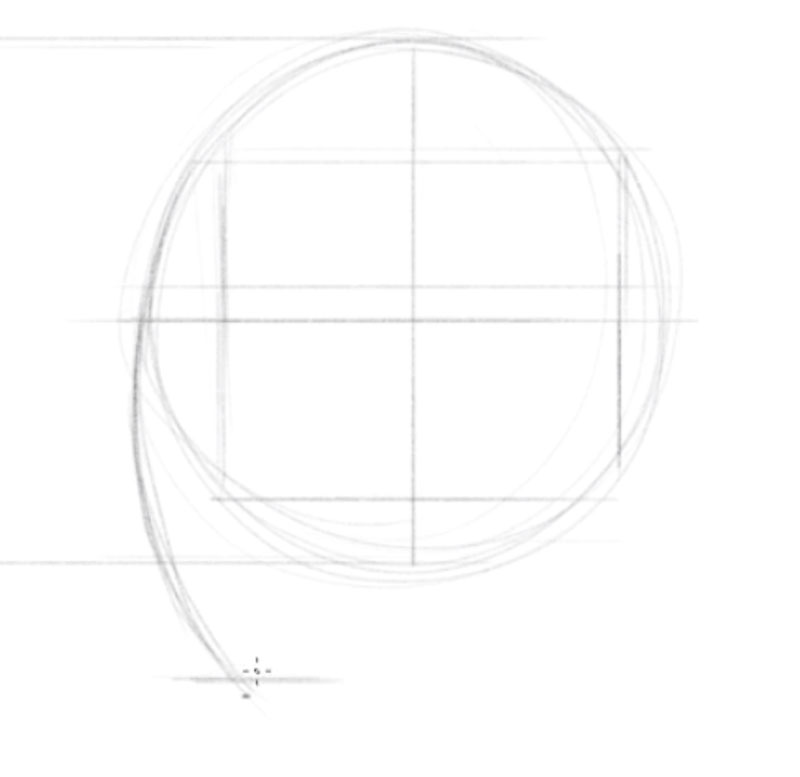
Footstep iii - Add together a Line from the Bottom of the Chin to the Center of the Foursquare
Next, we'll describe a line from the bottom of the chin to the center point on the bottom of the square. This line represents the jawline. This line will curve slightly in most cases.
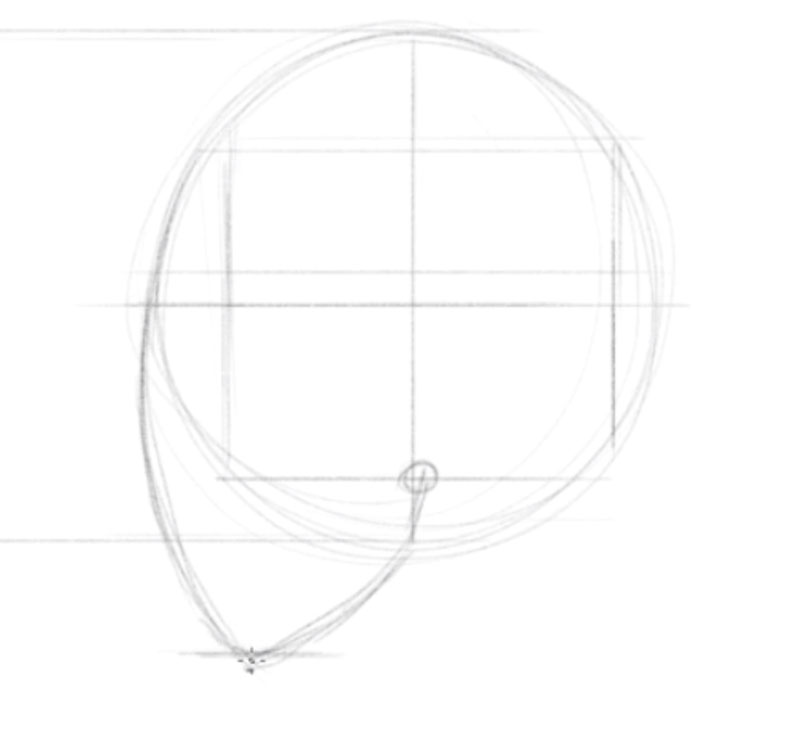
Step 4 - Determine the Location of the Eyes
Now we'll measure to the eye of the head and place a line to represent the eye line. Again, this line should be drawn only underneath the brow line.
We tin also apply the circle that we drew with the bottom of the square to draw the backside of the head. Call up about the construction of the skull hither as you draw this line.
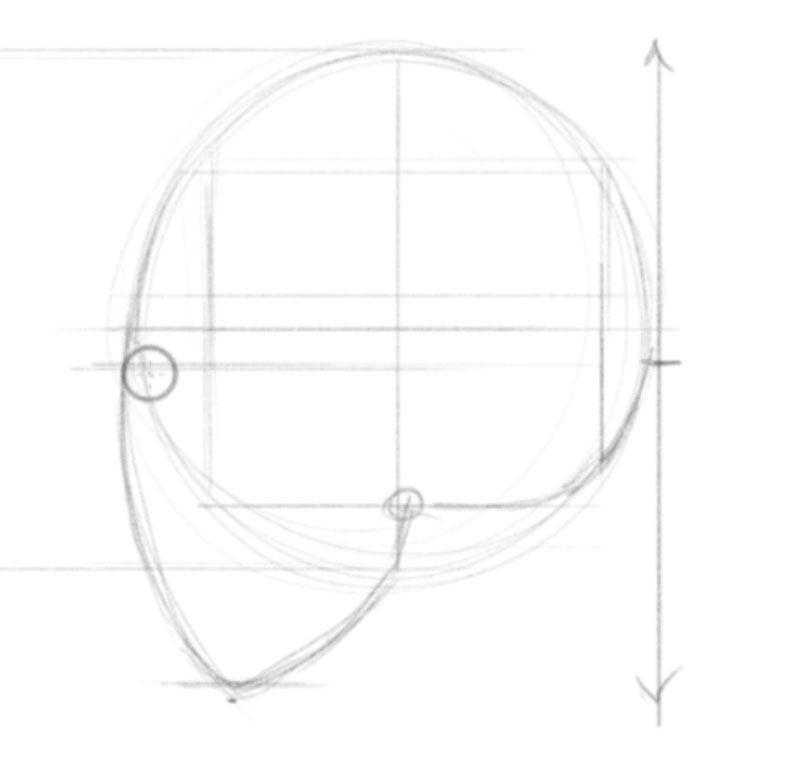
Footstep 5 - Describe the Facial Features and Add Shading
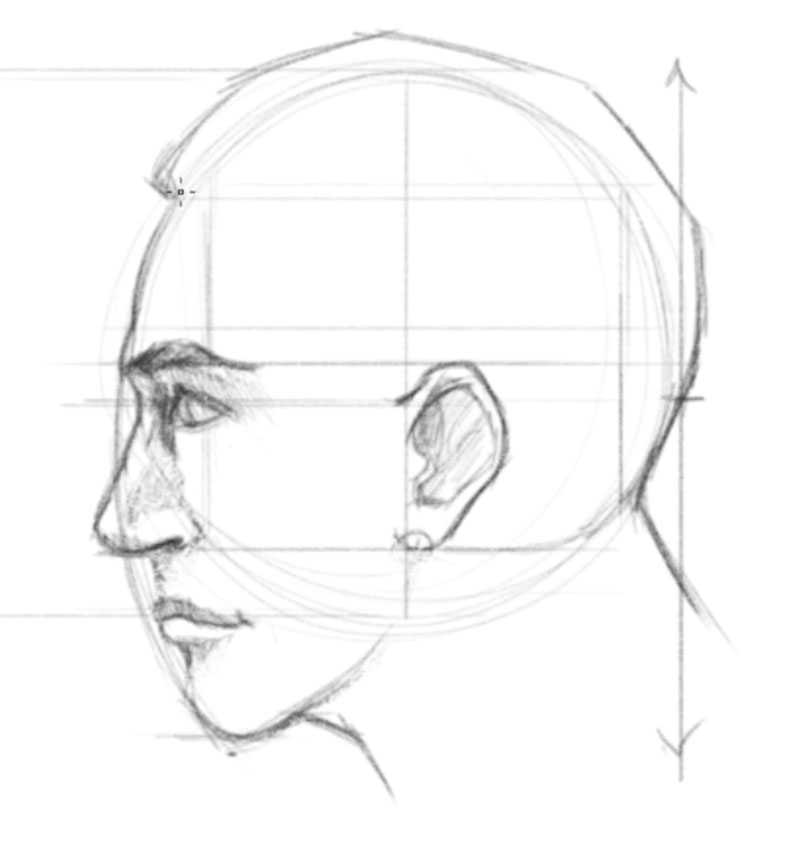
Now that we have an idea of the location of the facial features, we can describe them in using contour lines. Nosotros'll likewise add a bit of shading here to make the confront have a sense of form.
Observe how the eyes are set dorsum from the front edge of the face and how the lips and rima oris recede at a diagonal towards the cervix.
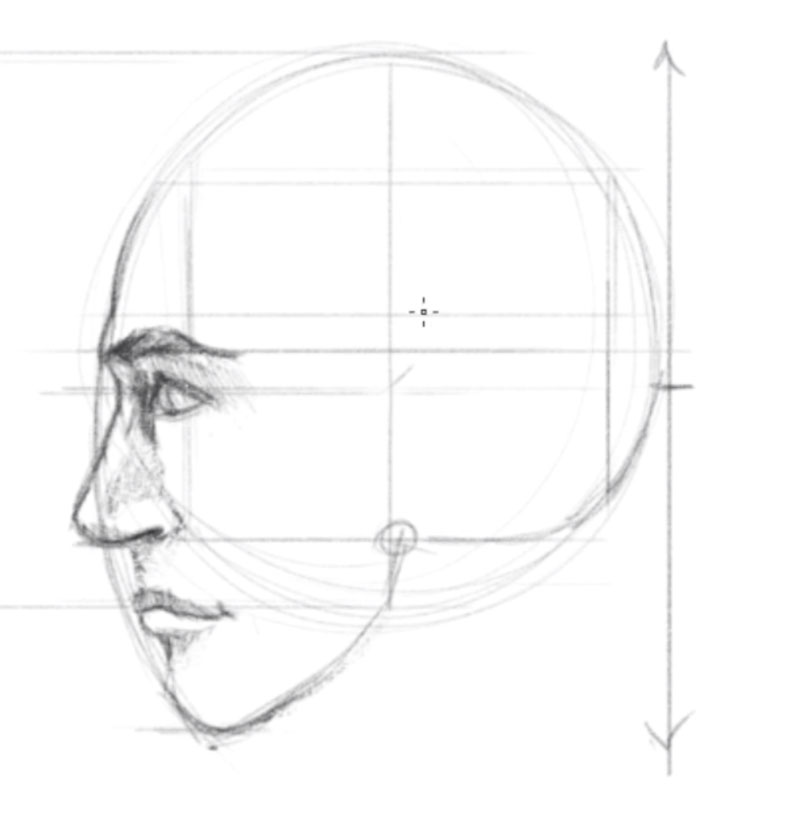
Step 6 - Depict the Ear on the Side of the Face
We can use our eye line, nose line, and center line to draw the ear on the side of the face. Since our subject is facing towards the left, the bulk of the ear will be constitute on the right side of our centre line.
As we discussed before, the line drawn for the ear will kickoff on the eye line, extend upward to the brow line and so curve downwardly, touching the olfactory organ line.
We'll too go alee and describe a contour line for the outer edge of the hair and a couple of contour lines for the neck in this step.
Step vii - Add the Pilus
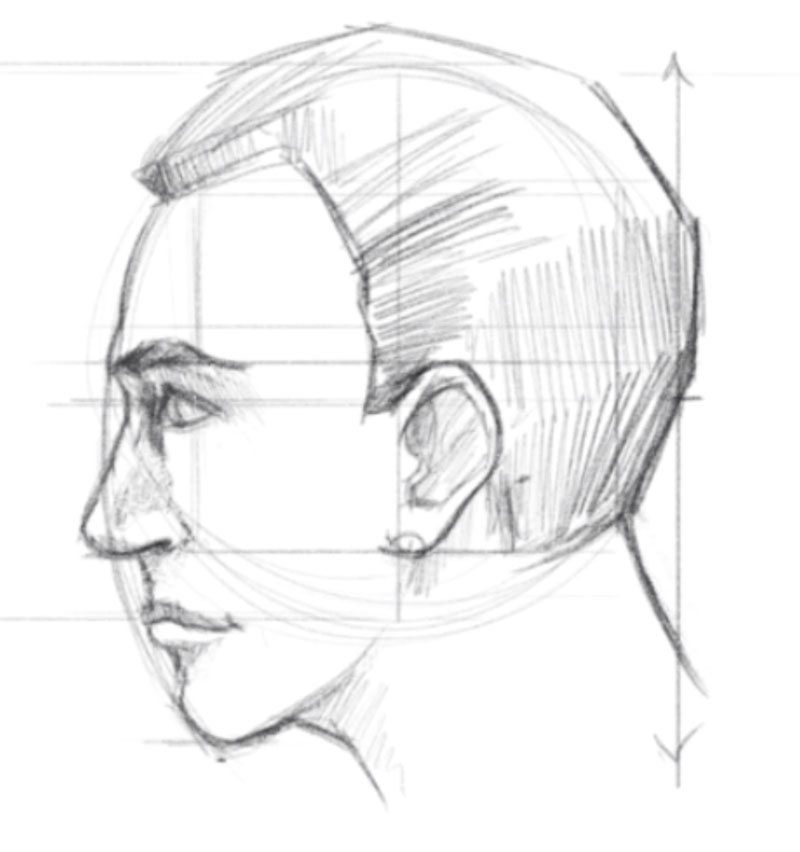
We'll go along the hair style consequent with our kickoff drawing and draw the hairline. In this case, the line extends back before making its way down to the ears.
We'll also add together a few hints of shading to make the hair feel like a form.
Summing Up The Andrew Loomis Approach to Drawing a Confront
(Some of the post-obit links are affiliate links which means nosotros earn a small commission if you lot purchase at no boosted cost to you lot.)
Andrew Loomis is revered for his step by step approach to drawing heads. As we covered above, his approach divides the caput into manageable geometric shapes. Each feature on the face up has a specific location relative to the geometric configuration set in the early stages of the drawing process. Because this method is so accurate, it's great to apply for drawing a caput from imagination.
But this arroyo is non express to cartoon faces from imagination. It likewise works when drawing a face from ascertainment. We simply take to proceed in heed that every person is different and variations of these specific proportions will be noticed.
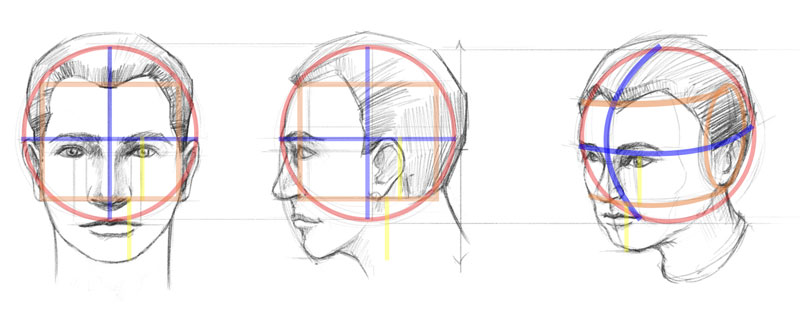
Here's a look at a face and caput drawn from imagination using the Loomis approach combined with a simpler approach which we hash out a little further down this page. All of the relationships and proportions are identified with the guidelines discussed.
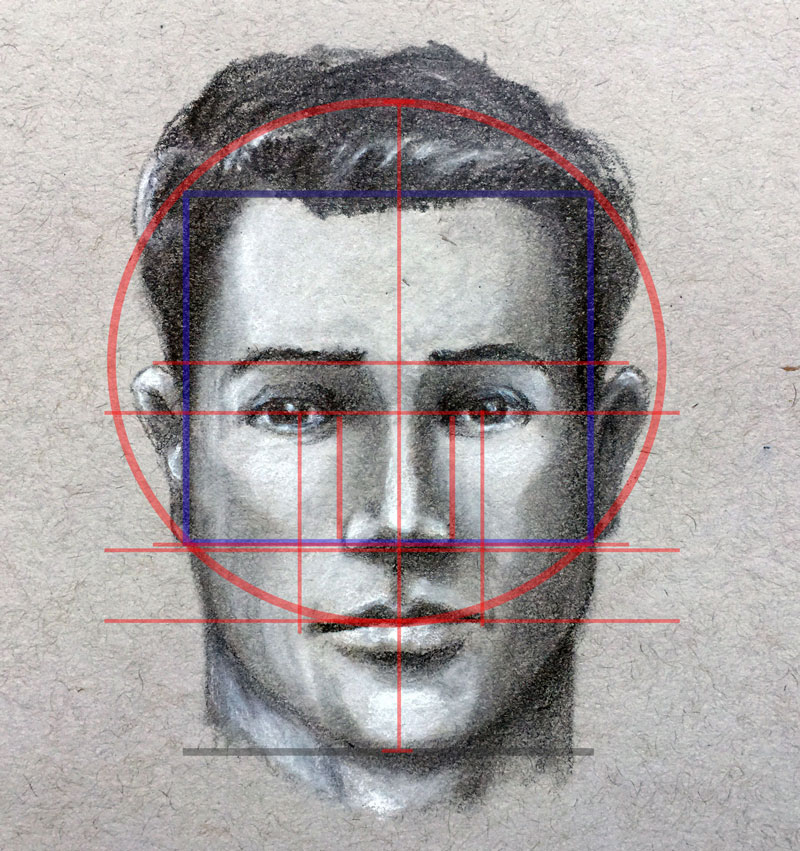
For more on the Loomis method for drawing heads, check out Module 4 from the "Portrait Cartoon The Smart Way" course or y'all can cheque out his book hither .

A Simple Approach to Drawing a Face
Some may discover the Loomis Method a little cumbersome for drawing. Luckily, there is a simpler approach. This approach borrows ideas from the Loomis Method, but simplifies a few of the steps. This formula should be used to help you meet and compare. In each stage of the formula, clarify each characteristic and describe what yous see. The upshot will exist a representational portrait of the person y'all are drawing with all of the features in the right place.
Drawing a portrait is very much similar drawing any other discipline thing. You have to closely observe the subject in order to depict it accurately. Of course portrait drawing is especially frail considering the goal is to make the portrait resemble the subject area closely.
If you know the person, the force per unit area to produce accuracy can be daunting. But every creative person, no matter what their skill level, should take heart. Even the most experienced and well-known portrait artists are presented with challenges. Consider these ii quotes from one of the all-time portrait painters of all time, John Singer Sargent...
"Every fourth dimension I pigment a portrait, I lose a friend."
"A portrait is a painting in which something is wrong with the mouth."
Almost of us can chronicle with both of these quotes. We've all felt the pressure when drawing or painting a portrait to make information technology wait exactly like our subject area - specially when that field of study is a friend. For some of united states of america, the force per unit area is so bang-up, we avoid portraits all together.
It'due south often hard to pinpoint a problem in a portrait. We can encounter that something isn't quite right, but finding the solution or the gear up can really throw some of the states. Frequently it'southward a combination of issues that lead to a "less than perfect" portrait. Peradventure something "is wrong with the mouth".
Even though representational portrait cartoon is reliant on good observation and accurate mark-making, we can still follow a simple procedure that volition lead to better results in our attempts.
Now, let's take a look at the simpler arroyo to drawing a face up.
I've taken all of the steps to drawing a confront with this simpler approach and put them into i image. The step by footstep instructions can be institute underneath the image. You'll notice that some of the steps are the same every bit nosotros discussed before, with the exception of using the foursquare to determine the hairline, forehead line, and nose line.
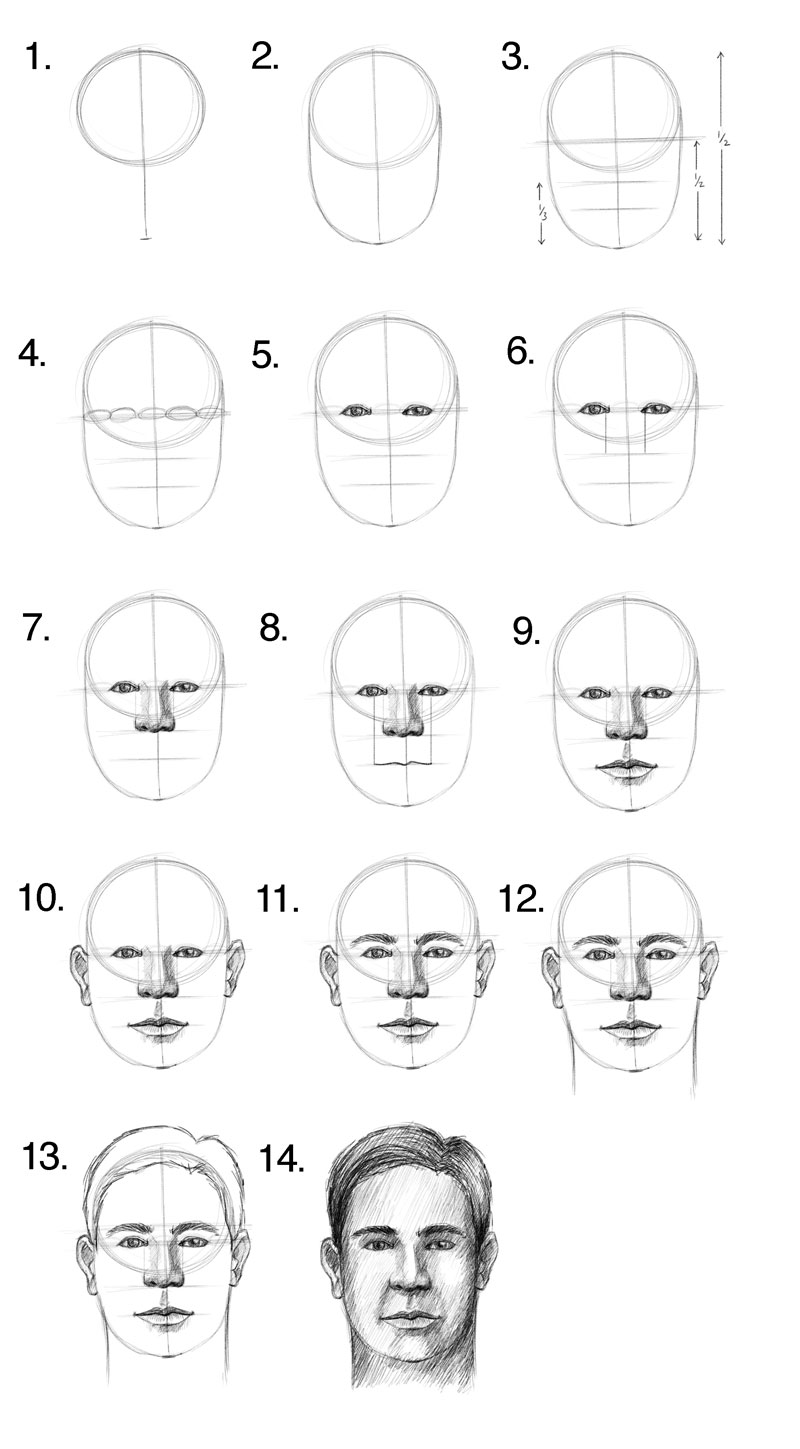
The first stride is to draw a circle to represent the cranium. Next, a line can be drawn to decide the length of the face (Step 1). For almost faces, this line should be approximately double the length of the original circle.
Next, lines are drawn from the bottom of that line to the edges of the circle creating the shape of the face up (Step 2). From hither, we tin can locate the positions of the facial features.
The "eye" line is in the middle of the face. (Your eyes aren't way up on your brow, and then resist the temptation to put them there.) A line is drawn to represent the eye line (Step 3).
The "olfactory organ" line is institute in the eye of the "center" line and the bottom of the mentum. When information technology comes to facial proportion, nearly noses volition terminate at this line (Step 3). Notwithstanding, there are exceptions to every rule. Some people have really long noses and some have really short ones.
The mouth line is found approximately one-tertiary of the manner down in betwixt the nose line and the bottom of the mentum. A line is loosely drawn for its location (Footstep three).
Adjacent, we'll concentrate on the optics. To detect the overall width of the eyes, depict 5 oval shapes across the centre line. Nigh faces are about "5 eyes" broad. Plain, people only have two optics. The "v optics" just help to determine the width of the eyes (Step 4).
Once we know the width of the eyes are authentic, we can draw them in the proper location (Stride 5).
Now, we'll determine the width of the nose. For near people, the width of the nose volition align with the inside corners of the eyes. We can simply depict two lines down from the inside corners of the eyes to the nose line to find the relative width of the nose (Step 6).
Once nosotros know the width of the nose, we can depict information technology in identify (Footstep 7).
At present, we can effigy the width of the mouth. This measurement varies from person to person, only for nigh folks, the width of the mouth aligns with the inside portions of the iris or the pupil. And then, we'll but depict a line straight down from this location to the mouth line to notice the corners of the oral cavity. We'll draw a line here to indicate where the upper lip meets the bottom lip (Step 8).
Then we tin can draw the upper and lower lips, knowing that the mouth is in the right spot (Step ix).
At present for the ears. Nosotros'll extend the center line out to make up one's mind the location where the elevation portion of the ears meet the head. They extend upward a fleck and line up with the forehead line. The bottom of the ears conveniently align with the nose line (Step ten).
Once we have the ears in place, we can add the middle brows. We'll use the tops of the ears to brand comparisons. For most people, the brow line aligns with the tops of the ears (Step eleven).
Before addressing the hair, we'll add a cervix. The cervix extends down from the lesser of the ears. For females, this lines extends inward a bit - resulting in a smaller cervix. For males, this line still comes in a bit, simply to a lesser degree. It's nearly directly downwards from the bottom of the ears (Pace 12).
The shape of the pilus is added side by side. In most cases, the hair extends off from the height of the cranium and may overlap portions of the forehead (Stride 13).
Lastly, shading is added to develop the illusion of form (Step fourteen).
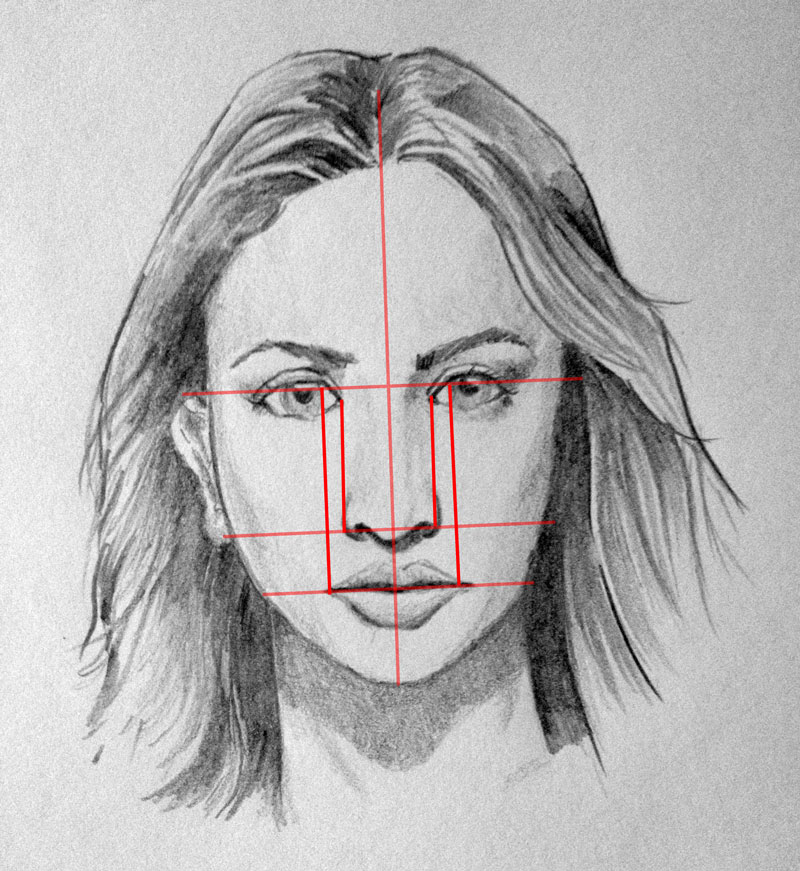
Reviewing the Generalized Locations of Facial Features
- The eyes are found in the centre of the head.
- The corners of the inside of the optics by and large line upwards with the edges of the olfactory organ.
- The "mouth" line is virtually 1-tertiary below the "olfactory organ" line and the bottom of the chin. This line represents where the pinnacle lip meets the bottom lip.
- The inside portions of the pupils or the iris more often than not line up with the corners of the oral cavity.
- The ears are normally found between the "eye" line and the "nose" line, but extend up to the brow line.
When drawing faces, use these standards to help you get your facial proportions right. Call up, y'all must look and study your field of study. While these standards employ to nigh of united states, they do not apply to all of united states.
Shading a Confront
Knowing where to place the facial features is clearly important, but in club to communicate a face in a drawing, we'll also need to add some shading. Shading is just the procedure of manipulating value (the darkness or lightness of a color).
The form of the face up is developed though the use of value and tone. The relationships of specific values inform the viewer of the location and strength of the light source. It is ultimately the beliefs of light on the head which creates the illusion of class.
To better understand how light behaves, nosotros can consider the planes of the caput and face up. By breaking the face down into elementary planes, we can ameliorate embrace how calorie-free behaves.
When shading, it's helpful to think of the head in terms of apartment planes. We tin see these planes illustrated below...
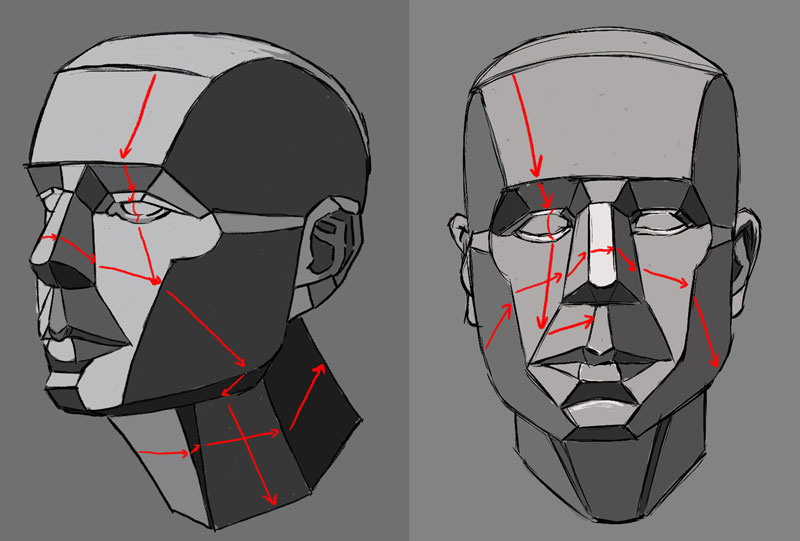
The planes of the face alter direction in space. These changes in direction produce different values depending on the location and forcefulness of the light source. In near cases, the low-cal source volition originate from above. This produces areas of darker tone in locations that recede and lighter ones in locations that protrude.
This means that recesses around the optics, under the olfactory organ, bottom lip, and chin are mostly shaded with darker values. Areas that protrude, such as the olfactory organ, cheek bones, chin, and lower lip consist mostly of lighter values.
Most faces volition have smooth transitions or gradations from calorie-free to dark. Creating smooth transitions in value are essential for communicating the texture of peel.
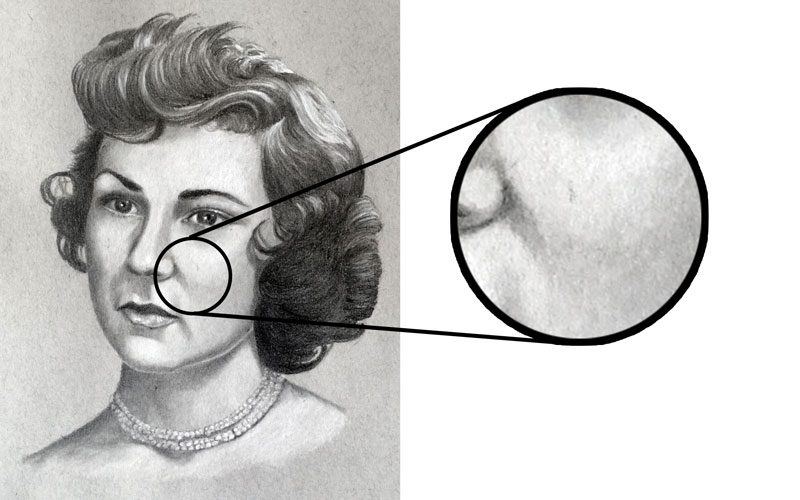
How you approach shading a confront will depend on the medium that you use to describe the face. For graphite, or pencil, y'all can simply adjust the amount of pressure that yous place on the pencil. For very smoothen or subtle transitions, you may choose to employ a blending stump.
Decision
When drawing a portrait, we take to remember that there's no "one size fits all" solution. At that place will be slight proportional differences from one person to the adjacent. We can utilise the techniques explored in this lesson to help us better understand the locations of the features of the face. Only if we want our portrait drawings to capture the likeness of the person, then nosotros must rely on observation to capture all of the nuances.
Now that you know how to draw a face up and the locations of the facial features, yous tin draw anyone that you wish. But remember, knowledge is only part of information technology. Yous must exercise in order to come across the best results with your drawings.
costellothentorcip.blogspot.com
Source: https://thevirtualinstructor.com/facialproportions.html
0 Response to "how to draw a 3d face on paper"
Post a Comment